
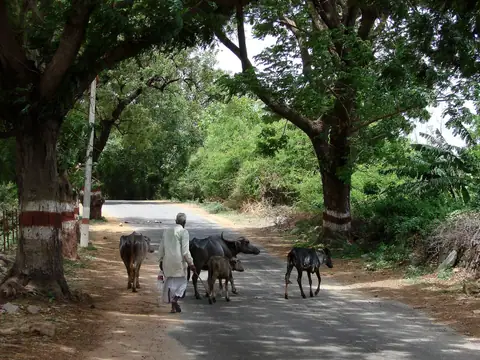
 Dairy & cattle
AHIDF
Animal Husbandry Infrastructure Development Fund
3%interest relief a year
3% a year off the interest on the loan, for up to 8 years.
Read from AHIDF realignment addendum (26.03.2024) · clause h) 9.1.2 · p. 3 · Our copy (PDF)
Private, free guide — not a government website. Apply only on the official portal.
Biogas, compressed biogas, crop residue and biomass pellets.
Dairy & cattle3% a year off the interest on the loan, for up to 8 years.
Biomass & bio-energyA fixed grant per biogas plant by size — ₹9,800 (1 m³) to ₹52,800 (20–25 m³), or ₹17,000 to ₹70,400 in hilly/north-eastern states and islands.
Biomass & bio-energyA custom hiring centre of a cooperative, FPO, SHG, panchayat or rural entrepreneur gets 80% of each machine’s price, up to the ceiling printed for that machine, and at most ₹24 lakh for the whole centre.
Biomass & bio-energyUp to ₹50 lakh per district for community (or, where feasible, household) biogas plants — the plant is built by the district, not paid to a farmer.
Biomass & bio-energy50% of the cost of one set of biomass collection machines, at most ₹90 lakh a set; a project gets ₹1.8 crore per 4 tonnes a day of CBG, at most ₹9 crore.
Biomass & bio-energy₹9 lakh per tonne-per-hour of briquette capacity, at most ₹45 lakh a plant (minimum plant size 1 tonne per hour).
Biomass & bio-energyBio-CNG from a new biogas plant: ₹4 crore for each 4,800 kg a day of capacity, at most ₹10 crore a project.
Highest share of cost any running scheme pays for this kind of work, by who applies. The amount is still capped by each scheme’s cost norm.
3% a year off the loan interest, for up to 8 years, on a cow-dung/urine processing, PROM or bio-CNG plant.
Covers phosphate-rich organic manure (PROM), bio-CNG, lignin extraction and other agri/animal waste plants; cow dung and urine collection, sheds, pits, tanks and processing machinery; and processing/marketing centres with packaging and a mobile marketing unit (Guidelines 3.0, cl. 6.6). Same benefit as every AHIDF activity: 3% a year off the interest for up to 8 years (2-year moratorium included), paid to your lender while the account is not an NPA; loan up to 90% of the project cost (Guidelines 3.0, cl. 8.1, 13.2). Not on land, working capital, pre-operative expenses, interest during construction, old assets or personal vehicles. One project claims it once, and not alongside another Central/State interest subvention (cl. 14).
“(vi) Animal Waste to Wealth Management (Agri Waste Management) … 9.1.2 … Henceforth new sanction made after 1.04.2024 will avail 3% Interest Subvention under the new realigned AHIDF Scheme.”A fixed grant per biogas plant by size — ₹9,800 (1 m³) to ₹52,800 (20–25 m³), or ₹17,000 to ₹70,400 in hilly/north-eastern states and islands.
The amount is a fixed central grant per plant, paid by MNRE to the state programme implementing agency (PIA) and passed on to you (para 10(i)). On top, Table-I adds ₹1,600 if the plant is linked to a sanitary toilet (1–10 m³ only) and ₹1,600 if linked to an MNRE-approved slurry filter unit (row B), and the PIA’s turnkey worker gets a job fee of ₹3,000 (1–10 m³) or ₹5,000 (15–25 m³) for fixed-dome/floating designs built on site (row C). Plants of 10–25 m³ that run a 100% biogas generator or water pump get ₹10,000 more (row G). We show the amount capped at your plant cost when you enter it.
“Table-I … Biogas Plants under Biogas Programme ranging from size 1 to 25 cubic Metre biogas per day (In ₹per plant) — A CFA Applicable: 1 M3 | 2-4 M3 | 6 M3 | 8-10 M3 | 15 M3 | 20-25 M3; (i) Hilly/NER States (Arunachal Pradesh, Assam, Himachal Pradesh, Jammu & Kashmir, Ladakh, Manipur, Meghalaya, Mizoram, Nagaland, Sikkim, Tripura and Uttarakhand) (ii) Island; and (iii) Scheduled Castes (SC)/ Scheduled Tribes(ST): 17,000 | 22,000 | 29,250 | 34,500 | 63,250 | 70,400; (iv) All other States and Categories: 9,800 | 14,350 | 22,750 | 23,000 | 37,950 | 52,800”SC and ST families in any state get the higher grant per plant — ₹17,000 (1 m³) to ₹70,400 (20–25 m³).
The amount is a fixed central grant per plant, paid by MNRE to the state programme implementing agency (PIA) and passed on to you (para 10(i)). On top, Table-I adds ₹1,600 if the plant is linked to a sanitary toilet (1–10 m³ only) and ₹1,600 if linked to an MNRE-approved slurry filter unit (row B), and the PIA’s turnkey worker gets a job fee of ₹3,000 (1–10 m³) or ₹5,000 (15–25 m³) for fixed-dome/floating designs built on site (row C). Plants of 10–25 m³ that run a 100% biogas generator or water pump get ₹10,000 more (row G). We show the amount capped at your plant cost when you enter it.
“Table-I … Biogas Plants under Biogas Programme ranging from size 1 to 25 cubic Metre biogas per day (In ₹per plant) — A CFA Applicable: 1 M3 | 2-4 M3 | 6 M3 | 8-10 M3 | 15 M3 | 20-25 M3; (i) Hilly/NER States (Arunachal Pradesh, Assam, Himachal Pradesh, Jammu & Kashmir, Ladakh, Manipur, Meghalaya, Mizoram, Nagaland, Sikkim, Tripura and Uttarakhand) (ii) Island; and (iii) Scheduled Castes (SC)/ Scheduled Tribes(ST): 17,000 | 22,000 | 29,250 | 34,500 | 63,250 | 70,400; (iv) All other States and Categories: 9,800 | 14,350 | 22,750 | 23,000 | 37,950 | 52,800”For a medium biogas plant that generates 3 to 50 kW of power: up to ₹45,000 per kW.
This is the ceiling for the 3–50 kW band; we count at most 50 kW. Larger plants get ₹40,000 per kW (>50–200 kW, a DPR is required) and ₹35,000 per kW (>200–250 kW), and plants used for heat or cooling get half these rates per kWeq (Table-II). North-eastern states, islands, registered gaushalas and SC/ST get 20% more than Table-II — not added in our figure (Table-II, note **).
“Table-II … Power generating Capacity 3 kW-50 kW — Requirement of DPR: No — CFA** limited to the following ceiling limit: Power Generation ₹45,000 per kW; Thermal Application ₹22,500 per kWeq thermal/ cooling … ** Special Incentives for NER, Island, Registered Gaushalas; and SC/ST: An incentive of 20% over and above the CFA mentioned in Table-II.”50% of the price of one stubble-management machine for a farmer, up to the ceiling printed for that machine (for example ₹1,20,000 for a super seeder).
States add their own conditions and may add machines to the list (Annexure-I, Note (b)); in Punjab and Haryana see the state records for the current round. Preference goes to farmers who already own a matching tractor (cl. 5.1(iii)). Machines costing ₹1 lakh or more must be geo-referenced (cl. 6.0(vi)).
“5.1 Financial assistance to farmers for procurement of crop residue management machines on individual ownership basis — (i) Financial assistance @ 50% of the cost of machinery. (ii) The list of machines identified for crop residue management together with ceiling limit for subsidy is indicated in Annexure-I. … Note: (a) The financial assistance will be limited to 50% of the cost of the machine or the maximum permissible subsidy per machine as indicated above, whichever is lower.”A custom hiring centre of a cooperative, FPO, SHG, panchayat or rural entrepreneur gets 80% of each machine’s price, up to the ceiling printed for that machine, and at most ₹24 lakh for the whole centre.
This works out one machine at a time; add up the machines in your project, and the total subsidy cannot pass ₹24,00,000 (cl. 5.2(vi)). A tractor alone is not allowed — it must come with 2–3 straw machines (cl. 5.2(iii)). The subsidy is credit-linked: a bank loan is needed, though a state may exempt projects up to ₹10 lakh if every payment goes through the bank (cl. 5.2, criteria (i)).
“5.2 Establishment of Custom Hiring Centres of Crop Residue Management Machines — (i) Credit Linked Back Ended Subsidy @ 80% of the project cost for the projects costing up to Rs. 30 lakhs/project … (iii) The maximum permissible assistance per machine under the CHC project is indicated in Annexure-II. … (vi) … The project cost may also exceed Rs. 30 lakhs. However, the maximum permissible subsidy for each project should not exceed Rs. 24.00 lakhs per project.”A paddy-straw collection project (balers, rakes, loaders) gets 65% of the machinery cost, counting at most ₹1 crore for a medium-baler project and ₹1.5 crore for a big-baler project.
Enter the machinery cost from the proforma invoices; tractors alone are not allowed (cl. 5.3(vi)–(vii)). Under a bilateral agreement with a straw-using industry, the beneficiary puts in at least 10% and the industry the rest; without one, the beneficiary pays the balance 35% (cl. 5.3(iv)–(v)). Annexure-IV sets indicative machine costs that we have not encoded.
“5.3 Establishment of crop residue/ paddy straw supply chain — (i) Credit Linked Back Ended Subsidy @ 65%, only on the capital cost of machines under the project. … (iii) For the purpose of financial assistance, the project cost will be limited to Rs. 1.00 Crores for the medium size baler project and Rs. 1.50 Crores for the Big Baler Projects.”Up to ₹50 lakh per district for community (or, where feasible, household) biogas plants — the plant is built by the district, not paid to a farmer.
Annexure-III: "at least one model community-level biogas plant per district is mandatory"; "Individual biogas plants are also allowed for households having cattle and in hilly areas". More plants can be set up with 15th Finance Commission grants or other funds following the MNRE biogas assistance norms (Annexure-III, Planning and Implementation).
“District level SLWM activities — GOBAR-Dhan Projects: Upto Rs.50 lakh per District”50% of the cost of one set of biomass collection machines, at most ₹90 lakh a set; a project gets ₹1.8 crore per 4 tonnes a day of CBG, at most ₹9 crore.
Enter the cost of one set; the number of sets is fixed from the biomass need in your DPR, and three sets with small balers count as one set with a large baler (cl. 4.1.3, 5.2(vi)). Machines must not already have any central or state subsidy (cl. 5.1(iv)) and cannot be sold for 5 years (cl. 7.1).
“4.1.1 A maximum financial assistance of 50% of the procurement cost of biomass aggregation machinery or Rs. 90 lakh per set (whichever is less) will be admissible as grant to a CBG producer. … 4.1.4 The financial assistance of Rs. 1.8 crore for 4 TPD CBG capacity project would be provided with a capping of Rs. 9 crore per project on pro rata basis.”₹9 lakh per tonne-per-hour of briquette capacity, at most ₹45 lakh a plant (minimum plant size 1 tonne per hour).
Only new machinery counts, and the plant must be at least 1 tonne per hour (cl. 3.6, 3.10). The full grant is paid after a performance test at 80% of rated capacity; less output gets a pro-rata share (amended cl. 4.4, OM of 27.06.2025).
“(a) Briquette manufacturing plant — Rs. 9.0 lakhs/MTPH (Maximum Rs. 45.0 lakhs per project)”Pellet plant: ₹21 lakh per tonne-per-hour or 30% of the plant and machinery cost, whichever is lower — at most ₹105 lakh a plant.
“(b) Non Torrefied Pellet manufacturing plant — Rs. 21.0 lakhs/MTPH production capacity or 30% of the capital cost considered for plant and machinery of 1 MTPH plant, whichever is lower (Maximum Rs. 105 lakhs per project)”Torrefied pellet plant: ₹42 lakh per tonne-per-hour or 30% of the plant and machinery cost, whichever is lower — at most ₹210 lakh a plant.
“(c) Torrefied Pellet manufacturing plant — Rs. 42.0 lakhs/MTPH production capacity or 30% of the capital cost considered for plant and machinery of 1 MTPH plant, whichever is lower (Maximum Rs. 210 lakhs per project)”Bio-CNG from a new biogas plant: ₹4 crore for each 4,800 kg a day of capacity, at most ₹10 crore a project.
Enter capacity as a multiple of 4,800 kg a day (e.g. 2,400 kg/day = 0.5). Bio-CNG from an existing biogas plant gets ₹3 crore per 4,800 kg/day (same row). Plants in the NE Region, Sikkim, Himachal Pradesh, Uttarakhand, Jammu & Kashmir, Ladakh, Lakshadweep and Andaman & Nicobar Islands, and cattle-dung plants of registered gaushalas, get 20% more (cl. 2.2) — not added in our figure. The full grant needs 80% of rated output in the performance test; lower output gets a pro-rata share, nothing below 50% (cl. 4.4, as amended by MNRE OM of 27.06.2025).
“2.1. Standard CFA pattern … 1 Biogas — Rs 0.25 Cr per 12000cum/day (maximum CFA of Rs. 5.0 Cr/project); 2 BioCNG / Enriched Biogas/ Compressed Bio Gas — Rs 4.0 Cr per 4800 kg/day (for BioCNG generation from new biogas plant); Rs 3.0 Cr per 4800 kg/day (for BioCNG generation from existing Biogas plant#); Maximum CFA of Rs. 10.0 Cr/project for both cases.”Large biogas plant: ₹25 lakh for each 12,000 m³ a day of biogas, at most ₹5 crore a project.
Plants up to 2,500 m³ a day (or 250 kW) belong to the Biogas Programme, not this one (cl. 3(v)). Plants in the NE Region, Sikkim, Himachal Pradesh, Uttarakhand, Jammu & Kashmir, Ladakh, Lakshadweep and Andaman & Nicobar Islands, and cattle-dung plants of registered gaushalas, get 20% more (cl. 2.2) — not added in our figure. The full grant needs 80% of rated output in the performance test; lower output gets a pro-rata share, nothing below 50% (cl. 4.4, as amended by MNRE OM of 27.06.2025).
“2.1. Standard CFA pattern … 1 Biogas — Rs 0.25 Cr per 12000cum/day (maximum CFA of Rs. 5.0 Cr/project); 2 BioCNG / Enriched Biogas/ Compressed Bio Gas — Rs 4.0 Cr per 4800 kg/day (for BioCNG generation from new biogas plant); Rs 3.0 Cr per 4800 kg/day (for BioCNG generation from existing Biogas plant#); Maximum CFA of Rs. 10.0 Cr/project for both cases.”