Livestock Insurance under the National Livestock Mission
85% of premiumpaid by government; you pay 15%
The government pays 85% of the premium to insure your animals for their market value against death; you pay 15%. The subsidy covers up to 10 cattle units per household (5 for pigs and rabbits; 10 sheep, goats, pigs or rabbits = 1 cattle unit).
Read from National Livestock Mission Guidelines (January 2025) · clause Activity III: Livestock Insurance, item 2 Salient Features (rate of premium; share of premium) and item 3 Funding Pattern · p. 42–43 · Our copy (PDF)
Government (Centre + State) pays 75% of the package cost — 90% for SC/ST — e.g. ₹5,62,500 of the ₹7,50,000 package for a 250-dfl mulberry unit.
Read from Central Silk Board — Silk Samagra-2 SOP & Guidelines (April 2022) · clause III A. Funding pattern for beneficiary-oriented Silk Samagra-2 packages/components, table 1 (Small and Marginal Farmers); 3.2.2 Package of assistance for silkworm rearing · p. 18, 40–41 · Our copy (PDF)
Livestock Health and Disease Control Programme (incl. NADCP and 1962 Mobile Veterinary Units)
FreeFMD vaccination every six months and one-time brucellosis vaccination of female calves, with vaccine, ear tag and vaccinator paid 100% by the Centre
Your cattle, buffaloes, sheep, goats and pigs are vaccinated against foot-and-mouth disease every six months, and female calves of 4 to 8 months once against brucellosis, with the vaccine, ear tag and vaccinator paid for by the Centre.
We could not confirm it is still openNot for you — check conditions
State Goat Entrepreneurship scheme
State Goat Entrepreneurship Development Scheme (Chhattisgarh)
33.3%of the cost, at most
For a 15-goat unit costing ₹1.50 lakh: 25% (up to ₹37,500) for general applicants, 33.3% (up to ₹50,000) for SC and ST.
Read from Chhattisgarh order of 24.06.2024 revising the State Goat Entrepreneurship Development Scheme · clause Scheme table, item 3 “पूंजी अनुदान (सहायता का प्रकार)”, with item 2 “इकाई लागत” ₹1.50 lakh · p. //2// (PDF p.3) · Our copy (PDF)
Special Development Package subsidies for sheep and goat rearers (Leh)
90%of the cost, at most
90% of a kid or lamb pen that protects newborn Pashmina kids from winter cold.
Read from UT Ladakh Sheep Husbandry Department — schemes page · clause Item H) Construction and installation of kid pen/Shed for pashmina goats · Our copy (PDF)
10+1 sheep/goat unit for SC and ST farmers (Karnataka Sheep & Wool Development Corporation)
25%of the cost, at most
25% of the ₹90,000 unit cost of 10 sheep/goats + 1 ram/buck — ₹22,500 — for an SC or ST beneficiary.
Read from Karnataka AH&VS “Schemes & Benefits” page — 2026-27 scheme details · clause 2026-27 Scheme Deatails, item 3 — Distribution of 10+1 Sheep/Goat Unit under Special component program /Tribal Sub plan · Our copy (PDF)
Small-scale native chicken poultry units with 50% subsidy (Tamil Nadu)
₹1,60,000per unit of 250 birds, at most
₹1.60 lakh back-ended subsidy (50%) for one 250-bird native chicken unit.
Read from Tamil Nadu Animal Husbandry Policy Note 2026-27 · clause 16.3 Poultry Development – Establishing 360 small scale native chicken farm units (250 chickens/unit) with 50% subsidy in Rural areas · p. PDF 91 (printed 88) · Our copy (PDF)
Free Kadaknath birds or turkey poults, and a free kit of 20 laying hens with feed and a cage.
Read from Puducherry Budget Speech 2025-26 (Chief Minister N. Rangasamy, 12.03.2025) · clause Para 19 (Animal Husbandry and Animal Welfare) · p. printed p.8 (PDF p.10) · Our copy (PDF)
Free one-year insurance for up to 2 milch cows or buffaloes, each valued at ₹3,000 (cow) or ₹4,000 (buffalo) per litre of daily milk, up to ₹40,000 an animal.
Read from Mukhyamantri Mangla Pashu Bima Yojana — scheme description 2025-26 · clause कीमत का निर्धारण, table row 1–2; पात्रता एवं आवेदन प्रक्रिया (अधिकतम 2 दुधारू पशु, 10 बकरी / 10 भेड़ / 10 उष्ट्र वंश पशु) · p. 1–2 · Our copy (PDF)
Assistance to set up a goat unit (10+1) for Scheduled Tribe beneficiaries, Gujarat
50%of the cost, at most
Scheduled Tribe beneficiaries: 50% of the goat-unit cost (10 does, 1 buck and upkeep), counted up to ₹1,20,000, so at most ₹60,000.
Read from Gujarat GR: goat units (10+1) for ST beneficiaries and livestock help for Halpati and FRA-title tribal families, 2026-27 · clause Conditions for the ST goat unit (10+1), cost table “એક બકરાં એકમ (૧૦+૧) માટે થનાર ખર્ચની વિગત” and “સહાયની વિગત” · p. 4 · Our copy (PDF)
Animal-husbandry assistance scheme for Halpati families and all tribal families holding FRA titles, Gujarat
100%of the cost, at most
Unit 1 — cattle feed: 100% of the cost, up to ₹4,000 (about 150 kg).
Read from Gujarat GR: goat units (10+1) for ST beneficiaries and livestock help for Halpati and FRA-title tribal families, 2026-27 · clause Standards of assistance table (સહાયના ધોરણો), item 1, cattle feed (ખાણદાણ) · p. 11 · Our copy (PDF)
SC/ST poultry units (75–90%) and SC goat unit (₹60,000)
Small-ruminant and poultry units for SC beneficiaries and poultry units for ST beneficiaries, Gujarat
90%of the cost, at most
SC: 1,000-broiler farm (1,500 sq ft shed, equipment, three batches of chicks and feed) — 90% of ₹9,06,000, at most ₹8,15,000 (₹3,60,000 capital + ₹4,55,000 running), once in a lifetime.
Read from Gujarat GR: goat and poultry units for SC beneficiaries, 2026-27 · clause 1,000-broiler farm, conditions 1–21 and cost table · p. 7–8 · Our copy (PDF)
Compensation for animal/poultry deaths from disease (₹37,500 a cow/buffalo)
Scheme to pay compensation for deaths of animals, poultry and ducks in epidemics, Gujarat
₹37,500per animal, at most
Milch cow, buffalo or camel: ₹37,500 each, up to 3 a family.
Read from Gujarat GR: compensation for deaths of animals, poultry and ducks in epidemics, 2026-27 · clause Condition 29 table, row 1; family limits condition 20 · p. 3 · Our copy (PDF)
Mukhyamantri Gramin Pashudhan Udyojakta Yojana (state-level) — dairy, goat/sheep, poultry, piggery and silage units
75%of the cost, at most
5 milch cows or buffaloes with 3-year insurance (₹5,60,180), shed (₹3,00,000) and equipment incl. 3 kW solar (₹2,75,000): 50% of ₹11,35,180 (₹5,67,590), SC/ST 75% (₹8,51,385).
Read from Maharashtra GR of 9 Mar 2026: CM Rural Livestock Entrepreneurship Scheme (state level) · clause परिच्छेद 7, 1) ५ दुधाळ गाय / म्हैस — प्रकल्पाची किंमत / अनुदानाचे स्वरुप · p. 4–5 · Our copy (PDF)
Fodder seed or slips: 100% up to ₹4,000 for 1 ha for an individual farmer (farmer groups up to 5 ha and ₹20,000), supplied in kind.
Read from Maharashtra GR of 9 Mar 2026: CM Rural Livestock Entrepreneurship Scheme (district annual plan) · clause परिच्छेद 6, 4) वैरण विकास योजना — अ) चारा उत्पादन कार्यक्रम — गटाची/उपकरणाची किंमत, अनुदानाचे स्वरुप · p. 10–11 · Our copy (PDF)
Nanaji Deshmukh Krishi Sanjivani (PoCRA) phase 2 — goat unit for landless families and single women
75%of the cost, at most
Landless-family members and widowed, deserted or divorced women in project villages: 75% of the approved cost of a 4 doe + 1 buck unit with 3 years’ insurance — up to ₹36,239 (Osmanabadi/Sangamneri) or ₹27,610 (other local breeds).
Read from PoCRA phase 2 guidelines: goat rearing · clause योजनेंतर्गत समाविष्ट घटक व अर्थसहाय्य 1–4 and table (does ₹8,000/₹6,000 each, buck ₹10,000/₹8,000, insurance ₹6,319/₹4,814; 75% subsidy ₹36,239/₹27,610) · p. 3 · Our copy (PDF)
Nanaji Deshmukh Krishi Sanjivani (PoCRA) phase 2 — sericulture: mulberry, rearing house and equipment
90%of the cost, at most
Mulberry planting: 75% (SC/ST 90%) of ₹60,000 an acre — ₹45,000 or ₹54,000 an acre.
Read from PoCRA phase 2 guidelines: sericulture (silk) unit · clause रेशीम उदयोग या घटका अंतर्गत समाविष्ट घटक व अर्थसहाय्य, table row १ (तुती लागवड) · p. 3 · Our copy (PDF)
Grazing subsidy (charai anudan) for Dhangar and other NT-C shepherd families, June–September
₹6,000per month
(June–September), at most
Grazing subsidy of ₹6,000 a month for the four months June–September — ₹24,000 in all — for a shepherd family with at least 20 sheep and 1 ram.
Read from Maharashtra GR of 20 Sep 2019: grazing subsidy for NT-C shepherd families · clause शासन निर्णय cl. 4(2)–(4); योजनेचे स्वरूप 6(3) · p. 2–3 · Our copy (PDF)
Land for stall-fed sheep, landless NT-C shepherds (75%, ≤ ₹50,000)
Land purchase or 30-year lease for semi-stall-fed and stall-fed sheep rearing — landless Dhangar and other NT-C shepherd families
75%of the cost, at most
One-time grant: 75% of the land price (at least 1 guntha) or of the rent payable on a lease of at least 30 years, up to ₹50,000.
Read from Maharashtra GR of 16 Sep 2019: land for stall-fed sheep rearing for landless NT-C shepherds · clause शासन निर्णय cl. 4(iii); योजनेचे स्वरूप 6(2)–(3) · p. 2–3 · Our copy (PDF)
100 backyard birds for NT-C families (75%, ₹9,000)
Backyard poultry for Dhangar and other NT-C families — 100 improved desi birds and feed at 75% subsidy
75%of the cost, at most
100 four-week-old improved desi birds (₹60 each) and 200 kg of feed for two months (₹30 a kg): 75% of ₹12,000 = ₹9,000.
Read from Maharashtra GR of 16 Sep 2019: 100 backyard birds at 75% for NT-C families · clause योजनेचे स्वरूप; योजनेचे आर्थिक निकष table rows 1–2 (feed read as 2 kg a bird per the corrigendum of 18.11.2019) · p. 1–2 · Our copy (PDF)
We could not confirm it is still openNot for you — check conditions
Goat unit 10 + 1 for NT-C women co-op members (75%)
Stall-fed goat unit (10 does + 1 buck) for women members of registered NT-C women’s co-operatives
75%of the cost, at most
Goat unit of 10 Osmanabadi / Sangamneri does + 1 buck: 75% of ₹87,857 (₹65,893 as printed).
Read from Maharashtra GR of 11 Sep 2019: 10 + 1 goat units for women members of NT-C women’s co-operatives · clause योजनेचे स्वरूप 6(10) · p. 3–4 · Our copy (PDF)
Poultry Development — Prani Sampad Samruddhi Yojana (layer, broiler, duck, chick-rearing and feed-mill units)
60%of the cost, at most
Layer farm, per 1,000 birds (up to 5,000): 60% / 50% of ₹8.225 lakh with a shed (₹4.935 lakh / ₹4.1125 lakh), or of ₹6.245 lakh (cage) / ₹4.825 lakh (deep litter) without one.
Read from Odisha PSSY layer farming guideline 2025-26 · clause Target Beneficiaries; 1. Subsidy Outlay if opted for shed (Layer-1000 to Layer-5000); Subsidy Outlay if not opted for shed · p. 2–4 · Our copy (PDF)
45% of the unit cost as a front-ended state subsidy: ₹2.25 lakh for a ₹5 lakh dairy, piggery or poultry unit, ₹2.70 lakh for a ₹6 lakh mithun unit, ₹6.75 lakh for a ₹15 lakh poultry enterprise unit.
Read from Lohit District — ANPPY 2025-26 circular inviting applications (28.10.2025) · clause Circular inviting applications for ANPPY 2025-26, table Sl. 1–5 (Unit cost; Govt. Subsidy 45%) · p. 1 · Our copy (PDF)
Ex-gratia for livestock killed and crops damaged by wild animals, Sikkim
₹12,000–₹30,000per animal killed
(calf ₹10,000; chicken ₹350/kg)
A fixed sum for each animal a wild animal kills: cow or bull ₹24,000, buffalo ₹25,000, calf ₹10,000, goat ₹12,000, sheep ₹20,000, pig ₹12,000, pony ₹15,000, yak or dzo ₹30,000, chicken ₹350 a kg.
Read from Sikkim Gazette No. 185 (2023) — compensation rates for livestock killed and crops damaged by wild animals · clause Notification No. 132/GOS/F&ED/SECY, cl. I (i)–(x) · p. 1 · Our copy (PDF)
Scheme for Providing Employment Opportunities by Establishing Piggery, Sheep and Goat Units (General), Haryana (2026-27)
25%of the cost, at most
Piggery of 10 sows and 1 boar: 25% of the cost, counted up to ₹1,00,000 — at most ₹25,000.
Read from Haryana piggery, sheep & goat units (General) 2026-27 · clause para 8 “Financial Assistance in form of subsidy …”; para 9 Piggery Unit table · p. 3 · Our copy (PDF)
Uttarakhand Poultry Development Policy 2025 — commercial layer and broiler parent farms
40%of the cost, at most
Commercial layer farm (15,000 birds) in a hilly area: 40% of the project cost, counted up to ₹1.20 crore — at most ₹48 lakh.
Read from Uttarakhand Poultry Development Policy 2025 — SOP GO (10 Oct 2025) · clause para 2, table 1 row 2 (पर्वतीय क्षेत्र) and the line “सब्सिडी: …” · p. 1–2 · Our copy (PDF)
Broiler Farm and Poultry Valley schemes, with the poultry feed subsidy (State Sector), Uttarakhand
₹60,000per broiler farm
Broiler farm (500 birds a batch): ₹15 a bird for 6 batches (₹45,000) plus ₹15,000 once for the shed — ₹60,000 per farm.
Read from Uttarakhand poultry feed subsidy scheme — SOP GO (30 Oct 2025) · clause “ब्रायलर फार्म की स्थापना योजना” — restating GO 1631/XV-1/22-1(15) 2022 of 15 Nov 2022, items 1–2 · p. 2 · Our copy (PDF)
We could not confirm it is still openNot for you — check conditions
UK Livestock Mission interest aid
Pashudhan Mission Yojana — payment of interest on loans (Chief Minister State Livestock Mission), Uttarakhand
90%of the loan interest
The state pays 90% of the interest on the bank loan for a listed dairy, mule, sheep/goat, pig or poultry unit.
Read from “Meri Yojana — State Government”, 2nd edition, Part 2 · clause पशुपालन विभाग, क्र0 1 “पशुधन मिशन योजना ऋण पर ब्याज भुगतान” — लाभ · p. 194 · Our copy (PDF)
We could not confirm it is still openNot for you — check conditions
Ladakh herder & flock support
Support for sheep and goat herders — Rarzi system, grazing-camp shelters, milk replacer and feed (Sheep Husbandry Department, UT Ladakh)
90%of the herder’s honorarium
Kargil village flocks (300–400 animals in towns, 500–600 in villages) grazing traditional pastures: the department pays 90% of the herder’s monthly honorarium for up to 5 summer months; the villagers pay 10%.
Read from UT Ladakh Sheep Husbandry Department — schemes page · clause A) item I “Rarzi System under Special Development Package (SDP) Component @ 90% subsidy … (For Kargil District)” · Our copy (PDF)
HADP — Self-sufficiency in mutton: sheep and goat units, Jammu & Kashmir
50%of the cost, at most
50% of the capital cost of a sheep/goat breeding farm (at least 500 females + 25 males), up to ₹50 lakh, paid in two instalments.
Read from J&K HADP — implementation guidelines of the 29 projects · clause Project 24 “Reorienting priorities: Self sufficiency in mutton production in J&K”, Salient Features ii–iii and Pattern of Assistance · p. printed 105 (PDF 106) · Our copy (PDF)
Other farmer100%Native chicken units (50%, ₹1.60 lakh)
Small or marginal farmer100%Native chicken units (50%, ₹1.60 lakh)
Woman farmer100%Native chicken units (50%, ₹1.60 lakh)
SC farmer100%Native chicken units (50%, ₹1.60 lakh)
ST farmer100%Native chicken units (50%, ₹1.60 lakh)
FPO100%Native chicken units (50%, ₹1.60 lakh)
Self-help group100%Native chicken units (50%, ₹1.60 lakh)
Cooperative100%Native chicken units (50%, ₹1.60 lakh)
Agri entrepreneur100%Native chicken units (50%, ₹1.60 lakh)
Highest share of cost any running scheme pays for this kind of work, by who applies. The amount is still capped by each scheme’s cost norm.
Every component for this, from the documents (112)
NLM National Livestock Mission — Entrepreneurship Development
01
50%of the cost, at most
Half the cost of a rural poultry parent farm, hatchery and mother unit, up to ₹25 lakh.
Read from National Livestock Mission Guidelines (January 2025) · clause 6.1.1 Activity I, item 4 (Funding pattern) · p. 12 · Our copy (PDF)
What the document says, word for word
The unit must have at least 1000 parent layers of low-input technology birds (item 2). No subsidy for working capital, a personal vehicle, buying land, or rent/lease of land. Paid through SIDBI to your lending bank in two equal instalments — the first after the bank releases its first loan instalment (or you spend 25% from your own share), the second when the project is complete.
“One Time 50% capital subsidy of the total project cost will be provided with maximum subsidy up to Rs. 25 lakhs for each unit.”
02
50%of the cost, at most
Half the cost of a sheep or goat breeding unit, with a ceiling set by the number of animals.
Read from National Livestock Mission Guidelines (January 2025) · clause 6.1 Activity II, item 3 (Pattern of Assistance); unit-size table at item 2 · p. 13–15 · Our copy (PDF)
What the document says, word for word
No subsidy for working capital, a personal vehicle, buying land, or rent/lease of land. Paid through SIDBI to your lending bank in two equal instalments — the first after the bank releases its first loan instalment (or you spend 25% from your own share), the second when the project is complete.
“50% capital subsidy up to ₹. 50 lakhs in two instalments.”
03
50%of the cost, at most
Half the cost of a pig breeder farm, up to ₹15 lakh or ₹30 lakh by size.
Read from National Livestock Mission Guidelines (January 2025) · clause 6.1 Activity IV, item 3 (Pattern of Assistance); unit-size table at item 2 · p. 18 · Our copy (PDF)
What the document says, word for word
No subsidy for working capital, a personal vehicle, buying land, or rent/lease of land. Paid through SIDBI to your lending bank in two equal instalments — the first after the bank releases its first loan instalment (or you spend 25% from your own share), the second when the project is complete.
“One time 50% capital subsidy of the total project cost will be provided with a maximum subsidy up to Rs. 30 lakhs for each unit subject to the scheme guidelines.”
04
50%of the cost, at most
Half the cost of an indigenous horse, donkey or camel breeder farm, with a ceiling set by the number of animals (₹3 lakh to ₹50 lakh).
Read from National Livestock Mission Guidelines (January 2025) · clause 6.1 Activity III, items 2–4 (Salient features, Eligible Entities, Funding pattern) · p. 15–17 · Our copy (PDF)
What the document says, word for word
Indigenous breeds only — no funding for thoroughbred horse farms. Covers housing, breeding animals, insurance, land preparation for fodder and equipment (Annexures IV–VI). No subsidy for working capital, a personal vehicle, buying land, or rent/lease of land. Paid through SIDBI to your lending bank in two equal instalments — the first after the bank releases its first loan instalment (or you spend 25% from your own share), the second when the project is complete.
“One Time 50% capital subsidy of the total project cost will be provided with maximum subsidy up to ₹ 50 lakh for each unit.”
05
Free90% of the unit, mostly as animals and inputs: 10 does/ewes + buck/ram up to ₹1,00,000; 5 does + 1 buck up to ₹50,000; 200-bird layer unit up to ₹50,000; 100-bird layer unit up to ₹25,000; 5 sows + 1 boar up to ₹60,000. You pay 10%.
For Scheduled Tribe forest-right (FRA patta) holders: 90% of a goat/sheep, layer-poultry or pig unit, given mostly as animals and inputs — up to ₹25,000 to ₹1,00,000 by unit.
Read from National Livestock Mission Guidelines (January 2025) · clause 5.12 with Annexure XVII (PM-JUGA), paras 4–5, Means of Finance, Channelling of subsidy · p. 9, 91–93 · Our copy (PDF)
What the document says, word for word
Only for Scheduled Tribe beneficiaries holding a patta under the Forest Rights Act, in PM-JUGA villages (500+ people with at least 50% ST, or aspirational-district villages with 50+ ST), who are trained in goat/sheep, backyard poultry or pig rearing and can pay their 10% share. The unit covers animals, a night shelter, feed for six months, veterinary care and one year of insurance. A district committee led by the Tribal Affairs department picks beneficiaries; the State is advised to give animals and inputs in kind, with only the shelter cost paid in cash to your Jan Dhan account. Item 1 prints "10 doe or ewe and one buck or ram" in its heading but "two buck or ram" in its text; item iv prints a ₹25,000 limit but also "subsidy will be provide of Rs. 50000/-" — we show the lower limit.
“a) Rearing of goat: The Central Government will provide 90% subsidy up to ₹100000 … i. Establishment of Breeding unit of 10 doe or ewe and one buck or ram … ii. Establishment of Breeding unit of5 doe and one buck: Subsidy will be provided up to 90% limited Rs 50000 … iii. Establishment of Poultry Unit for laying of eggs (200 birds’ unit): The Central Government will provide up to 90% subsidy limited to Rs. 50000/- … iv. Establishment of Poultry Unit for laying of eggs (100 birds’ unit): The Central Government will provide up to 90% subsidy limited to Rs. 25000/- … v. Establishment of Breeding unit of 5 sow and one boar unit: Subsidy will be provided upto 90% limited Rs 60000”
AHIDF Animal Husbandry Infrastructure Development Fund
01
3%interest relief a year
3% a year off the loan interest, for up to 8 years, on a modern sheep/goat or pig breeding farm, or an environment-controlled hatchery, layer or broiler-breeder poultry farm.
Read from AHIDF realignment addendum (26.03.2024) · clause a) Background, activity (iv); h) 9.1.2 · p. 1, 3 · Our copy (PDF)
What the document says, word for word
Sheep & goat breeding farms with technology upgradation (not traditional farming), goat frozen-semen and sheep semen stations; pig breeding and fattening farms and semen stations; technology-assisted poultry farms with parent/grandparent stock — environment-controlled hatcheries, layer and broiler-breeder farms, and integrated poultry farm-plus-feed projects (Guidelines 3.0, cl. 6.4.2–6.4.4). Same benefit as every AHIDF activity: 3% a year off the interest for up to 8 years (2-year moratorium included), paid to your lender while the account is not an NPA; loan up to 90% of the project cost (Guidelines 3.0, cl. 8.1, 13.2). Not on land, working capital, pre-operative expenses, interest during construction, old assets or personal vehicles. One project claims it once, and not alongside another Central/State interest subvention (cl. 14).
“(iv) Breed Improvement technology and Breed Multiplication Farm … 6.4.4 (d): Integrated projects for poultry farm and poultry feed with related activities … 9.1.2 … Henceforth new sanction made after 1.04.2024 will avail 3% Interest Subvention under the new realigned AHIDF Scheme.”
Government (Centre + State) pays 75% of the package cost — 90% for SC/ST — e.g. ₹5,62,500 of the ₹7,50,000 package for a 250-dfl mulberry unit.
Read from Central Silk Board — Silk Samagra-2 SOP & Guidelines (April 2022) · clause III A. Funding pattern for beneficiary-oriented Silk Samagra-2 packages/components, table 1 (Small and Marginal Farmers); 3.2.2 Package of assistance for silkworm rearing · p. 18, 40–41 · Our copy (PDF)
What the document says, word for word
Your 75% (or 90%) is the Central Silk Board share plus the State share; it depends on your state putting up its share. Special-status states get 90% for everyone; we cannot tell them from your state alone, so we show 75%. This pattern is for states outside the North East — NE projects follow separate project-based funding. The package covers plantation, irrigation, rearing house, equipment and disinfectants; parts can be moved within the package ceiling (32).
“The fund sharing pattern (%) for individual beneficiary-oriented Silk Samagra-2 components other than States in NE region: Category (Small and Marginal Farmers) — General States GOI (CSB) 50% State 25% Beneficiary 25%; General States – For SCSP & TSP 65% 25% 10%; Special Status States (for General, SCSP & TSP Category) 80% 10% 10%”
LHDCP Livestock Health and Disease Control Programme (incl. NADCP and 1962 Mobile Veterinary Units)
01
FreePPR vaccination of sheep and goats and swine-fever vaccination of pigs, 100% centrally funded
Your sheep and goats (including migrating flocks) are vaccinated against PPR and your pigs against classical swine fever, with the vaccine and vaccinator paid for by the Centre.
Sheep, goat and pig flocks are registered with one ear tag per flock on Bharat Pashudhan (cl. 2.4.5, 3.1.4 iv).
“3.1.2. Salient features — Under this component Government of India, centrally procure and supply PPR and CSF vaccines and small animal ear tags to States & UTs after quality control testing to ensure uniform quality. … 3.1.3. Funding pattern — For CADCP 100% funding is provided by the Central Government. 3.1.4 … ii. Vaccine Administration: Under PPR-EP, entire sheep and goat population of India, including migrant flocks are vaccinated … iii. Under CSF, entire pig population is vaccinated by CSF vaccine”
02
FreeCompensation for animals or birds culled, and feed or eggs destroyed, in an outbreak (Centre:State 50:50; rate set per outbreak, not printed)
If your poultry, pigs or horses are culled to stop bird flu, African swine fever or glanders, or your poultry feed and eggs are destroyed, the state pays you compensation, with the Centre bearing half.
Read from LHDCP Operational Guidelines (May 2025) · clause 3.2.3 Funding pattern (second bullet); 3.2.4 (b); Annexure-6 Payment for compensation to farmer for culling · p. 23, 45 · Our copy (PDF)
What the document says, word for word
The guidelines print no rupee rate per bird or animal — Annexure-6 says compensation is “given as per demand & report submission”. Your state animal husbandry department pays it after the culling operation.
“3.2.4 … b. … Assistance shall also be given for ring vaccination to inhibit the spread of the diseases (in cases of disease outbreaks) as well as towards payment of compensation to farmers for culling of poultry birds, elimination of infected animals, destruction of poultry feed /eggs, including operational costs. … Annexure-6: PAYMENT FOR COMPENSATION TO FARMER FOR CULLING (50:50) i ASF (African Swine Fever) ii AI (Avian Influenza) iii Glanders — Given as per demand & report submission in 50:50”
A one-time ₹12,500, paid in three instalments, to a rural landless agricultural household to start one livelihood unit of its choice.
Read from Odisha CM-KISAN guideline (2024-25) · clause Quantum of benefit (Livelihood support for Landless Agricultural Households) · p. 3 · Our copy (PDF)
What the document says, word for word
For rural landless labourers who depend on agriculture as their main activity and are permanent residents of Odisha (“Eligibility criteria”, p.2). Apply with your MGNREGS job card.
“Under Livelihood support for Landless Agricultural Households, financial assistance of Rs. 12,500/- to be provided in three installments for enhancing the income and overall wellbeing of rural landless agricultural households.”
For a 15-goat unit costing ₹1.50 lakh: 25% (up to ₹37,500) for general applicants, 33.3% (up to ₹50,000) for SC and ST.
Read from Chhattisgarh order of 24.06.2024 revising the State Goat Entrepreneurship Development Scheme · clause Scheme table, item 3 “पूंजी अनुदान (सहायता का प्रकार)”, with item 2 “इकाई लागत” ₹1.50 lakh · p. //2// (PDF p.3) · Our copy (PDF)
What the document says, word for word
Unit cost ₹1.50 lakh (item 2): 2 bucks at ₹12,000 and 13 does at ₹7,500, plus utensils, one year’s insurance and 3 months’ feed (item 1). The component table gives SC/ST ₹50,000 and others ₹37,500 in all; 33.3% of ₹1.50 lakh works out to ₹49,950. The goat shed is not funded — build it yourself or through MGNREGA. Women’s self-help groups in gauthans get priority (item 4, point 4). One person per joint family; no repeat benefit for 5 years (item 4, points 8–10).
“सामान्य श्रेणी हितग्राही हेतु इकाई लागत का 25 प्रतिशत, अधिकतम रू. 37500.00 अ.जा./अ.ज.जा. हितग्राही हेतु कुल वित्तीय लागत का 33.3 प्रतिशत, अधिकतम रू. 50000.00”
₹15,000one-time, for 3 breedable pigs (insurance included)
₹15,000 once, including the insurance of the pigs, for a rural household rearing at least three breedable pigs over 50 kg and 5 months old.
Read from Sikkim Gazette No. 54 (10.03.2022) — Pig Production Incentive Scheme guidelines · clause A.5; A.6; A.14 · p. 1–2 · Our copy (PDF)
What the document says, word for word
Rural areas only, not urban or municipal areas (A.2). The piggery farm must first be registered by the district committee (A.3). One person per household, as a one-time incentive (A.4). Pigs counted must weigh over 50 kg and be over 5 months old, with no more than one male among the three breedable pigs; every pig gets a permanent tag or tattoo (A.5, A.7, A.11). The three breedable pigs must be insured for a year at 4% of a ₹12,000 market value per pig, and may not be sold during the insurance period or till first farrowing; the premium is paid to the insurer out of the incentive (A.6, A.14). Pigs must be vaccinated against swine fever and FMD (C.1). The guidelines date from 2022 and we found no 2025-26 or 2026-27 order confirming the scheme is still open — check with your Veterinary office.
“The household shall rear at least three breedable pigs in which the male shall not be more than one and each pig shall have live body weight of more than 50 kg and shall be above 5 months of age in order to be eligible to receive incentive under the scheme. Such household shall receive an incentive of Rs. 15,000/- including the cost of insurance of 3 breedable pigs.”
02
Up to ₹50,000in total, as the herd grows to 4–10, 11–20 or 21+ pigs
As the herd of pigs over 50 kg and 5 months grows, the total incentive rises to ₹25,000 (4–10 pigs), ₹35,000 (11–20 pigs) or ₹50,000 (21 pigs or more).
Read from Sikkim Gazette No. 54 (10.03.2022) — Pig Production Incentive Scheme guidelines · clause A.7; A.8; A.9 · p. 2 · Our copy (PDF)
What the document says, word for word
Rural areas only, not urban or municipal areas (A.2). The piggery farm must first be registered by the district committee (A.3). One person per household, as a one-time incentive (A.4). Pigs counted must weigh over 50 kg and be over 5 months old, with no more than one male among the three breedable pigs; every pig gets a permanent tag or tattoo (A.5, A.7, A.11). The three breedable pigs must be insured for a year at 4% of a ₹12,000 market value per pig, and may not be sold during the insurance period or till first farrowing; the premium is paid to the insurer out of the incentive (A.6, A.14). Pigs must be vaccinated against swine fever and FMD (C.1). The guidelines date from 2022 and we found no 2025-26 or 2026-27 order confirming the scheme is still open — check with your Veterinary office.
“Once the number of pigs having live body weight of more than 50 kg with a minimum age of 5 months in the farm under the same household reaches the range of 4-10 pigs, the farmer shall be eligible to receive a total incentive of Rs. 25,000/- therefore, additional Rs. 10,000 as an incentive will be paid. … reaches the range of 11-20 pigs, the farmer shall be eligible to receive a total incentive of Rs. 35,000/- therefore, additional Rs. 10,000 as an incentive will be paid. … reaches 21 pigs and above, the farmer shall be eligible to receive a total incentive of Rs. 50,000/- therefore, additional Rs. 15000 as an incentive will be paid.”
₹6,000one-time honorarium to a selected livestock farmer
₹6,000 by DBT if you are selected and keep at least one crossbred cow, 10 adult female goats or one crossbred sow.
Read from Tripura BMS scheme SOP (CMYJ3) — Mukhyamantri Prani Palak Samman Nidhi · clause Eligibility (as per guidelines), item 1–2; Benefits table (Benefit Amounts 6000) · p. 1 · Our copy (PDF)
What the document says, word for word
Selection is limited: the table speaks of honouring 5,000 livestock farmers in a year and of choosing families who did not get the honorarium in the previous round, so this is not an entitlement for every farmer. The benefits table says “Yearly”, but each round selects new families; we show it as a one-time honorarium. The table is reproduced in the BMS scheme SOP, not in a separately published order.
“Selected livestock farmers having at least one crossbreed cow /10 female adult goats/ one crossbreed sow will be provided an honorarium of Rs 6,000 /- 2)Honorarium will be provided through DBT mode.”
75% of a starter unit of Pashmina, dairy goat or Merino animals (5 females + 1 male, or 9 + 1).
Read from UT Ladakh Sheep Husbandry Department — schemes page · clause A) New approved Schemes under SDP (Object Head 33-Subsidies), item A · Our copy (PDF)
What the document says, word for word
Leh district only. Priority for rearers who lost animals to wild or dog attacks; selection by departmental officers, approved by the Councillor.
“Provision of Subsidy for establishment of 10 units of 5 Nos. of (5F+1M)/05 Nos. of (9F+1M) units of Pashmina/Dairy goat/ Merino in Leh district @ 75% subsidy Mode: 75% Govt share, 25 % beneficiary share.”
02
75%of the cost, at most
75% of a livestock shed or chain-link enclosure that keeps dogs and wild animals out.
Read from UT Ladakh Sheep Husbandry Department — schemes page · clause A) New approved Schemes under SDP (Object Head 33-Subsidies), item B · Our copy (PDF)
What the document says, word for word
Leh district only. You need at least 30 sheep or goats in an area prone to dog or wild-animal attacks; you build the platform yourself.
“Provision of subsidy for establishment of livestock shed I Chain link in Leh district @ 75% subsidy. Mode: 75% Govt share; 25% beneficiary share.”
03
75%of the cost, at most
75% of a solar electric fence against dog attacks.
Read from UT Ladakh Sheep Husbandry Department — schemes page · clause A) New approved Schemes under SDP (Object Head 33-Subsidies), item C · Our copy (PDF)
What the document says, word for word
Pilot in Leh district. At least 30 sheep or goats; sheep and goat breeders’ cooperatives get preference.
“Pilot project on provision of subsidy on electric fencing to curb dog attacks on 75% subsidy (Leh District). Mode: 75% Govt share, 25% beneficiary share.”
04
75%of the cost, at most
75% of a portable wool-shearing machine, given after training.
Read from UT Ladakh Sheep Husbandry Department — schemes page · clause A) New approved Schemes under SDP (Object Head 33-Subsidies), item D · Our copy (PDF)
What the document says, word for word
Leh district only. At least 30 sheep; selected in descending order of flock size and recommended by the Councillor.
“Subsidy on wool shearing machine @ 75% subsidy to progressive sheep rearers of Leh district (Leh District). . Mode: 75% Govt. share, 25% subsidy share.”
05
75%of the cost, at most
75% of a spinning machine for wool and Pashmina, for livestock owners.
Read from UT Ladakh Sheep Husbandry Department — schemes page · clause A) New approved Schemes under SDP (Object Head 33-Subsidies), item E · Our copy (PDF)
What the document says, word for word
Leh district only. You need at least 30 sheep or goats; beneficiaries are identified by the department and approved by the area Councillor.
“Provision of spinning unit @75% subsidy to progressive sheep rearers of Leh district(Leh District).”
06
75%of the cost, at most
75% of a 2-tonne bio-fertilizer plant that turns sheep and goat manure into saleable fertilizer.
Read from UT Ladakh Sheep Husbandry Department — schemes page · clause A) New approved Schemes under SDP (Object Head 33-Subsidies), item F · Our copy (PDF)
What the document says, word for word
Leh district only. At least 50 sheep or goats; community rearers may also apply; only 10 units for 2025-26.
“Subsidy on Organic bio fertilizer plant with 2 tonnes capacity @ 75% subsidy to Sheep and Goat rearers with more than 50 no of sheep/goat holdings(Leh District). Mode: 75% Govt.share, 25% beneficiary share.”
07
90%of the cost, at most
90% of a kid or lamb pen that protects newborn Pashmina kids from winter cold.
Read from UT Ladakh Sheep Husbandry Department — schemes page · clause Item H) Construction and installation of kid pen/Shed for pashmina goats · Our copy (PDF)
What the document says, word for word
Leh district (Changthang). 200–300 animals: 1 pen; 300–500: 2 pens; 500 and above: 3 pens.
“Construction and installation of kid pen/Shed for pashmina goats @ 90 % subsidy (Leh District).”
50% of the cost of a piggery, poultry, goatery or dairy unit as subsidy, with a bank loan for the rest.
Read from Meghalaya Budget Speech 2026-27 · clause Para 3.2.3 · p. 10 · Our copy (PDF)
What the document says, word for word
The 2025-26 speech records 1,357 people sanctioned the 50% credit-linked subsidy for rearing pigs (para 6.1). The 2026-27 speech adds fish farmers to CM-ELEVATE from 2026-27 (para 3.2.4) and new CM-ELEVATE schemes for polyhouses, collection centres, cold storages and fish ponds at 50% to 75% (para 3.6.2) — rates for those are not printed item by item, so they are not shown here.
“To boost productivity, the State is scaling up livestock entrepreneurship under CM-Elevate by providing subsidies and credit support across piggery, poultry, goatery and dairy sectors. About 2,000 entrepreneurs have been supported with 50% credit linked subsidy.”
₹7,500per sheep or goat over 6 months lost in an accident (₹5,000 for 3–6 months)
₹7,500 for a sheep or goat over 6 months, or ₹5,000 for one aged 3–6 months, that dies in an accident.
Read from Karnataka AH&VS “Schemes & Benefits” page — 2026-27 scheme details · clause 2026-27 Scheme Deatails, item 4 — Ex-gratia for accidental death of small animals · Our copy (PDF)
What the document says, word for word
“Ex-gratia for accidental death of small animals (Karnataka Sheep & Wool Development Corporation): For accidental death, an amount of Rs.7500/- for sheep/goats above 6 months and Rs. 5000/- for sheep/goats aged 3-6 months, compensation will be distributed to their owners.”
10+1 sheep/goat unit (SC/ST) 10+1 sheep/goat unit for SC and ST farmers (Karnataka Sheep & Wool Development Corporation)
01
25%of the cost, at most
25% of the ₹90,000 unit cost of 10 sheep/goats + 1 ram/buck — ₹22,500 — for an SC or ST beneficiary.
Read from Karnataka AH&VS “Schemes & Benefits” page — 2026-27 scheme details · clause 2026-27 Scheme Deatails, item 3 — Distribution of 10+1 Sheep/Goat Unit under Special component program /Tribal Sub plan · Our copy (PDF)
What the document says, word for word
Only for Scheduled Caste and Scheduled Tribe beneficiaries. The page prints the beneficiary’s 75% (₹67,500) as “voluntary”; it does not say whether a bank loan is arranged for it.
“Distribution of 10+1 Sheep/Goat Unit under Special component program /Tribal Sub plan (Karnataka Sheep & Wool Development Corporation): Unit | Unit Cost | Subsidy 25% Percent | Beneficiary Voluntary 75% — 10+1 sheep/goat unit distribution to Scheduled caste and scheduled tribe beneficiaries | Rs:90,000/- | Rs:22500/- | Rs.67500/-”
Read from Tamil Nadu Revised Budget speech 2026-27 (5 Aug 2026) · clause 67 (Animal Husbandry) — ‘Vetri Magalir Goat Rearing Scheme’ · p. 36 · Our copy (PDF)
What the document says, word for word
Only for destitute widows, deserted women, transgender persons and persons with disabilities living in rural areas — our applicant types cannot express this, so check the condition yourself.
“under the ‘Vetri Magalir Goat Rearing Scheme’, five goats or sheep will be provided with a 100 per cent subsidy to destitute widows, deserted women, transgender persons and persons with disabilities living in rural areas, benefiting about 30,000 eligible persons.”
₹1.60 lakh back-ended subsidy (50%) for one 250-bird native chicken unit.
Read from Tamil Nadu Animal Husbandry Policy Note 2026-27 · clause 16.3 Poultry Development – Establishing 360 small scale native chicken farm units (250 chickens/unit) with 50% subsidy in Rural areas · p. PDF 91 (printed 88) · Our copy (PDF)
What the document says, word for word
The ₹1.60 lakh is the subsidy amount (50% of the unit); the Policy Note describes the 2025-26 pattern and announces 100 more units at the same 50% back-ended subsidy for the current year. One unit per beneficiary.
“Under this scheme, each beneficiary was provided 50% back ended subsidy of Rs.1.60 lakh for the establishment of the unit including poultry shed, purchase of equipment like feeder and waterer, besides feed cost for 4 months. 250 numbers of 4-week-old Native chicks are provided to each beneficiary through Departmental Farms.”
Free Kadaknath birds or turkey poults, and a free kit of 20 laying hens with feed and a cage.
Read from Puducherry Budget Speech 2025-26 (Chief Minister N. Rangasamy, 12.03.2025) · clause Para 19 (Animal Husbandry and Animal Welfare) · p. printed p.8 (PDF p.10) · Our copy (PDF)
What the document says, word for word
The speech does not say how many Kadaknath birds or poults each family gets.
“To tap backyard poultry and to enhance rural economy by selling meat and egg, 6 weeks grown 12,000 Kadaknath birds, 25,000 Turkey poults will be distributed free of cost. Further, a kit of 20 egg laying hens, feed and cage will be distributed free of cost to 2,500 beneficiaries.”
₹20,000 for each camel calf born to your she-camel (2026-27 amount), for calves registered at 0–2 months of age.
Read from Rajasthan Output-Outcome Budget 2026-27 · clause Animal Husbandry Department, item 6 "Subsidy for camel conservation": "Financial assistance to camel breeders with an incentive amount of Rs 20,000"; ₹15 crore, 3,500 breeders in 2026-27 · p. Page 17 (PDF p.26) · Our copy (PDF)
What the document says, word for word
The 2023 scheme note paid ₹10,000 per calf in two instalments of ₹5,000; the 2026-27 Output-Outcome Budget prints ₹20,000. We did not find the order that raised it, so the instalment split of the ₹20,000 is not shown. 100% here only shows a fixed amount per calf.
“Financial assistance to camel breeders with an incentive amount of Rs 20,000”
Scheduled Tribe beneficiaries: 50% of the goat-unit cost (10 does, 1 buck and upkeep), counted up to ₹1,20,000, so at most ₹60,000.
Read from Gujarat GR: goat units (10+1) for ST beneficiaries and livestock help for Halpati and FRA-title tribal families, 2026-27 · clause Conditions for the ST goat unit (10+1), cost table “એક બકરાં એકમ (૧૦+૧) માટે થનાર ખર્ચની વિગત” and “સહાયની વિગત” · p. 4 · Our copy (PDF)
What the document says, word for word
Unit cost: 10 does at ₹5,000 and 1 buck at ₹10,000 (₹60,000) plus upkeep ₹60,000 — feed/water equipment, shelter and fencing, fodder, medicine and other costs (p.4). You bear 50% of feed, water, fodder, housing and concentrate cost (condition 17) and must keep the unit 3 years (condition 18). 25% of the benefit is for women; once per family in a lifetime (conditions 2–3).
“સહાયની વિગત : રૂ. ૧,૨૦,૦૦૦/- યુનિટ કિંમતના ૫૦% મુજબ મહત્તમ રૂ. ૬૦,૦૦૦/- અથવા ખરેખર થયેલ ખર્ચ, બે માંથી જે ઓછુ હોય તે”
Unit 2 — goat unit of 5 does and 1 buck: 90% of the cost, counted up to ₹56,000, so at most ₹50,400.
Read from Gujarat GR: goat units (10+1) for ST beneficiaries and livestock help for Halpati and FRA-title tribal families, 2026-27 · clause Annexure-2 (પરિશિષ્ટ-૨), unit (2) goat unit (5+1), conditions 1–8 and cost table · p. 6 · Our copy (PDF)
What the document says, word for word
Unit cost ₹56,000: 5 does at ₹5,000, 1 buck ₹10,000, fodder and feed ₹15,400, other ₹5,600; you bear 10% (₹5,600). Keep the unit 3 years (conditions 4–6).
“સહાયની વિગત : એક બકરાં એકમ ખર્ચ ₹.૫૬,૦૦૦/-ના ૯૦% મુજબ મહત્તમ ₹.૫૦,૪૦૦/- અથવા ખરેખર થયેલ ખર્ચ, બે માંથી જે ઓછુ હોય તે.”
02
75%of the cost, at most
Unit 3 — 100-bird broiler unit: 75% of the cost, up to ₹36,000 (a unit costs about ₹48,000), plus a ₹2,000 poultry-training stipend.
Read from Gujarat GR: goat units (10+1) for ST beneficiaries and livestock help for Halpati and FRA-title tribal families, 2026-27 · clause Standards of assistance table (સહાયના ધોરણો), item 1, poultry training stipend & 100-broiler unit (મરઘાં પાલન તાલીમ સ્ટાઈપેન્ડ & ૧૦૦ બ્રોઈલર પક્ષી યુનિટ) · p. 11 · Our copy (PDF)
What the document says, word for word
The ₹2,000 stipend is paid for the training (Annexure-3, condition 1, p.6) and is not in this amount. The unit must run at least two years with four batches; help is given on the first batch only (condition 8, p.7).
“તાલીમ સ્ટાઈપેન્ડ રૂ.૨,૦૦૦/- તથા ૧૦૦ બ્રોઈલર પક્ષી યુનિટ કુલ ખર્ચનાં ૭૫% સહાય મહત્તમ રૂ.૩૬,૦૦૦/- કુલ રૂ.૩૮,૦૦૦/-”
SC: goat unit of 10 does + 1 buck with upkeep — 50% of ₹1,20,000, at most ₹60,000, once in a lifetime per family.
Read from Gujarat GR: goat and poultry units for SC beneficiaries, 2026-27 · clause Annexure-1, goat unit (10+1) conditions 1–12 and cost table · p. 4–5 · Our copy (PDF)
What the document says, word for word
Does 1–2 years old and a buck 2–3 years old; you bear 50% of feed, fodder and housing; keep the unit for three years (conditions 8–10). ST families have the separate 10+1 goat scheme (gj-st-bakra-ekam-10-plus-1).
“સહાયની વિગત રૂ. ૧,૨૦,૦૦૦/- યુનિટની કિંમતના ૫૦% મુજબ મહત્તમ રૂ.૬૦,૦૦૦/- અથવા ખરેખર થયેલ ખર્ચ બે માંથી જે ઓછુ હોય તે.”
02
75%of the cost, at most
SC: unit of 25 RIR/Kadaknath birds (6–8 weeks old) with feed — 75% of ₹8,000 = ₹6,000, given as birds and feed; you bring the night coop and feeders (₹2,000).
Read from Gujarat GR: goat and poultry units for SC beneficiaries, 2026-27 · clause Annexure-1, 25 RIR/Kadaknath unit, condition 4 and cost table · p. 5–6 · Our copy (PDF)
What the document says, word for word
Only for those who took poultry training in the current year; once in a lifetime per family; keep the unit for 2 years.
“આમ આ યોજના હેઠળ કુલ એકમ ખર્ચ રૂ. ૮૦૦૦/-ના ૭૫% લેખે રૂ. ૬૦૦૦/- સહાય આપવાની રહેશે જ્યારે એકમનો ૨૫% ખર્ચ રૂ. ૨૦૦૦/- લાભાર્થીએ પોતાના ફાળા તરીકે ભોગવવાનો રહેશે.”
03
75%of the cost, at most
ST: unit of 25 RIR/Kadaknath birds (6–8 weeks old) with feed — 75% of ₹8,000 = ₹6,000, given as birds and feed; you bring the night coop and feeders (₹2,000).
Read from Gujarat GR: Kadaknath/RIR and broiler poultry units for ST beneficiaries, 2026-27 · clause 25 RIR/Kadaknath unit, condition 4 and cost table · p. 4 · Our copy (PDF)
What the document says, word for word
Only for those who took poultry training in the current year; once in a lifetime per family; keep the unit for 2 years.
“આમ આ યોજના હેઠળ કુલ એકમ ખર્ચ રૂ. ૮૦૦૦/-ના ૭૫% લેખે રૂ. ૬૦૦૦/- સહાય આપવાની રહેશે જ્યારે એકમનો ૨૫% ખર્ચ રૂ. ૨૦૦૦/- લાભાર્થીએ પોતાના ફાળા તરીકે ભોગવવાનો રહેશે.”
04
75%of the cost, at most
SC: 100-broiler farm (10×10 ft shed, equipment, chicks, feed) — 75% of ₹48,000, at most ₹36,000, once in a lifetime.
Read from Gujarat GR: goat and poultry units for SC beneficiaries, 2026-27 · clause 100-broiler unit, conditions 1–16 and cost table · p. 6–7 · Our copy (PDF)
What the document says, word for word
You need poultry training, your own (or 5-year leased) land, and must keep the farm for at least two years with two batches a year.
“આમ, ૧૦૦ બ્રોઈલર પક્ષીના ફાર્મ માટે કુલ રૂ. ૪૮૦૦૦/-ના ખર્ચની સામે સહાયના ૭૫% ધોરણ અનુસાર લાભાર્થી દીઠ રૂ. ૩૬૦૦૦/-ની નાણાકીય સહાય ચુકવવામાં આવશે.”
05
75%of the cost, at most
ST: 100-broiler farm (10×10 ft shed, equipment, chicks, feed) — 75% of ₹48,000, at most ₹36,000, once in a lifetime.
Read from Gujarat GR: Kadaknath/RIR and broiler poultry units for ST beneficiaries, 2026-27 · clause 100-broiler unit, condition 8 and cost table · p. 9–10 · Our copy (PDF)
What the document says, word for word
You need poultry training, your own (or 5-year leased) land, and must keep the farm for at least two years with two batches a year.
“આમ, ૧૦૦ બ્રોઈલર પક્ષીના ફાર્મ માટે કુલ રૂ. ૪૮૦૦૦/-ના ખર્ચની સામે સહાયના ૭૫% ધોરણ અનુસાર લાભાર્થી દીઠ રૂ. ૩૬૦૦૦/-ની નાણાકીય સહાય ચુકવવામાં આવશે.”
06
90%of the cost, at most
SC: 1,000-broiler farm (1,500 sq ft shed, equipment, three batches of chicks and feed) — 90% of ₹9,06,000, at most ₹8,15,000 (₹3,60,000 capital + ₹4,55,000 running), once in a lifetime.
Read from Gujarat GR: goat and poultry units for SC beneficiaries, 2026-27 · clause 1,000-broiler farm, conditions 1–21 and cost table · p. 7–8 · Our copy (PDF)
What the document says, word for word
New poultry farms only; the farm must be at least 500 m from habitation and 100 m from water bodies, and run for at least three years. A family that got similar help under another scheme is not eligible.
“આમ, ૧૦૦૦ બ્રોઇલર ફાર્મના એક એકમની સ્થાપના માટે થનાર ખર્ચ કુલ: રૂ. ૯,૦૬,૦૦૦/- ના ૯૦% લેખે મહત્તમ રૂ.૮,૧૫,૦૦૦/- સહાય મળવાપાત્ર રહેશે … અનાવર્તક ખર્ચ માટે મહત્તમ સહાય રૂ.૩,૬૦,૦૦૦/- અને આવર્તક ખર્ચ માટે મહત્તમ સહાય રૂ.૪,૫૫,૦૦૦/- મળવાપાત્ર રહેશે”
07
90%of the cost, at most
ST: 1,000-broiler farm (1,500 sq ft shed, equipment, three batches of chicks and feed) — 90% of ₹9,06,000, at most ₹8,15,000 (₹3,60,000 capital + ₹4,55,000 running), once in a lifetime.
Read from Gujarat GR: Kadaknath/RIR and broiler poultry units for ST beneficiaries, 2026-27 · clause 1,000-broiler farm, cost table · p. 6 · Our copy (PDF)
What the document says, word for word
New poultry farms only; the farm must be at least 500 m from habitation and 100 m from water bodies, and run for at least three years. A family that got similar help under another scheme is not eligible.
“આમ, ૧૦૦૦ બ્રોઇલર ફાર્મના એક એકમની સ્થાપના માટે થનાર ખર્ચ કુલ: રૂ. ૯,૦૬,૦૦૦/- ના ૯૦% લેખે મહત્તમ રૂ.૮,૧૫,૦૦૦/- સહાય મળવાપાત્ર રહેશે … અનાવર્તક ખર્ચ માટે મહત્તમ સહાય રૂ.૩,૬૦,૦૦૦/- અને આવર્તક ખર્ચ માટે મહત્તમ સહાય રૂ.૪,૫૫,૦૦૦/- મળવાપાત્ર રહેશે”
Adult hens or ducks: ₹100 a bird, up to 100 birds (₹10,000).
Read from Gujarat GR: compensation for deaths of animals, poultry and ducks in epidemics, 2026-27 · clause Condition 29 table, row 5; family limits condition 20 · p. 3 · Our copy (PDF)
What the document says, word for word
For deaths from anthrax, rabies, bird flu, poisoning (food, chemical, snake bite) and other diseases — not mass deaths in floods, drought, earthquake or cyclone, which the Revenue Department compensates (preamble, condition 24). Not paid if the animal was insured or died through the owner’s plain neglect; the animal must be in the owner’s name in the village register (conditions 21–23). A post-mortem report (except rabies) and a panchnama are needed (conditions 25–26).
50 goats/sheep + 5 bucks/rams with 3-year insurance, shed (₹2,00,000), chaff cutter (₹30,000) and 3 kW solar (₹1,32,000): 50% of ₹11,38,554 (₹5,69,277), SC/ST 75% (₹8,53,915).
Read from Maharashtra GR of 9 Mar 2026: CM Rural Livestock Entrepreneurship Scheme (state level) · clause परिच्छेद 7, 2) शेळी मेंढी पालन — प्रकल्पाची किंमत / अनुदानाचे स्वरुप · p. 6–7 · Our copy (PDF)
What the document says, word for word
Does/ewes priced at ₹12,000 and bucks/rams at ₹15,000, aged 1–3 years, bought first from the Punyashlok Ahilyadevi Sheep & Goat Development Corporation (or elsewhere on its non-availability certificate). Same land and training conditions as the dairy unit. General beneficiaries 50%, SC and ST beneficiaries 75%. Selection online by the district committee on a first-come-first-served basis (corrigendum 27.08.2026, item 5); 5% of places for the disabled and 30–50% for women. One person per family; not if a similar central/state benefit was taken in the last 3 years. Any cost above the norm is paid by the beneficiary. Not in Mumbai and Mumbai Suburban districts (General instructions 1–4).
“शेळी मेंढी पालन प्रकल्पाद्वारे उद्योजकता विकास योजना — ५०+५ शेळी /मेंढी … प्रकल्पाची एकूण किंमत - रु.११,३८,५५४/- ; सर्वसाधारण लाभार्थी - ५० टक्के (रु. ५,६९,२७७/-) ; अनुसुचित जाती जमाती प्रवर्गातील लाभार्थी - ७५ टक्के (रु. ८,५३,९१५/-)”
02
75%of the cost, at most
5,000 day-old layer chicks (200+ eggs a year), a month’s feed, shed up to ₹15 lakh, equipment and 3 kW solar: 50% of ₹30,00,000 (₹15,00,000), SC/ST 75% (₹22,50,000).
Read from Maharashtra GR of 9 Mar 2026: CM Rural Livestock Entrepreneurship Scheme (state level) · clause परिच्छेद 7, 3) अ) अंडी देणाऱ्या सुधारित कुक्कुट — प्रकल्पाची किंमत / अनुदानाचे स्वरुप · p. 9–10 · Our copy (PDF)
What the document says, word for word
Open to all categories — marginal and small farmers, forest-rights holders, educated unemployed and women’s groups — with at least 20 guntha of land (owned or 5-year lease) and 2 years’ poultry experience or training. The first instalment needs the bank’s loan sanction order. General beneficiaries 50%, SC and ST beneficiaries 75%. Selection online by the district committee on a first-come-first-served basis (corrigendum 27.08.2026, item 5); 5% of places for the disabled and 30–50% for women. One person per family; not if a similar central/state benefit was taken in the last 3 years. Any cost above the norm is paid by the beneficiary. Not in Mumbai and Mumbai Suburban districts (General instructions 1–4).
“अंडी देणाऱ्या सुधारित कुक्कुट / देशी पक्षांचे वाटप … प्रकल्प एकूण किंमत - रु.३०,००,०००/- ; सर्वसाधारण लाभार्थी - ५० टक्के (रु. १५,००,०००/-) ; अनुसुचित जाती जमाती प्रवर्गातील लाभार्थी- ७५ टक्के (रु. २२,५०,०००/-)”
03
75%of the cost, at most
Broiler unit (shed at 1.2 sq ft a bird and ₹250 a sq ft, feeders/drinkers ₹50 a bird, solar): 3,000 birds ₹12,00,000 or 5,000 birds ₹19,00,000 — 50% (₹6,00,000 / ₹9,50,000), SC/ST 75% (₹9,00,000 / ₹14,25,000).
Read from Maharashtra GR of 9 Mar 2026: CM Rural Livestock Entrepreneurship Scheme (state level) · clause परिच्छेद 7, 3) आ) मांसल कुक्कुट 3000 ते 5000 — प्रकल्पाची किंमत / अनुदानाचे स्वरुप · p. 11–12 · Our copy (PDF)
What the document says, word for word
Same eligibility as the layer unit (20 guntha, experience or training, bank loan consent). The solar item is not allowed if solar help was taken under another scheme. General beneficiaries 50%, SC and ST beneficiaries 75%. Selection online by the district committee on a first-come-first-served basis (corrigendum 27.08.2026, item 5); 5% of places for the disabled and 30–50% for women. One person per family; not if a similar central/state benefit was taken in the last 3 years. Any cost above the norm is paid by the beneficiary. Not in Mumbai and Mumbai Suburban districts (General instructions 1–4).
“पशुपालक/शेतकऱ्यांना देशी/ सुधारित मासंल कुक्कुट 3000 ते 5000 पर्यंत पक्षांच्या संगोपनाद्वारे उद्योजकता विकास — प्रकल्पाची एकूण किंमत-३००० पक्षी- रु. १२,००,०००/- ; ५००० पक्षी- रु. १९,००,०००/-”
04
75%of the cost, at most
Incubator and hatcher for 1,000 eggs a week (₹2,08,000) with 3 kW solar (₹1,32,000): 50% of ₹3,40,000 (₹1,70,000), SC/ST 75% (₹2,55,000).
Read from Maharashtra GR of 9 Mar 2026: CM Rural Livestock Entrepreneurship Scheme (state level) · clause परिच्छेद 7, 3) इ) अंडी उबवणी संयंत्र — प्रकल्पाची किंमत / अनुदानाचे स्वरुप · p. 14 · Our copy (PDF)
What the document says, word for word
Open to landless, marginal and small farmers, educated unemployed and women’s groups with 2 years’ poultry experience or training; the hatchery must start within two months of selection. General beneficiaries 50%, SC and ST beneficiaries 75%. Selection online by the district committee on a first-come-first-served basis (corrigendum 27.08.2026, item 5); 5% of places for the disabled and 30–50% for women. One person per family; not if a similar central/state benefit was taken in the last 3 years. Any cost above the norm is paid by the beneficiary. Not in Mumbai and Mumbai Suburban districts (General instructions 1–4).
“१००० प्रति आठवडा अंडी उबवणी क्षमतेच्या संयंत्राचा (Incubator, Hatcher) पुरवठा — एकूण किंमत ३,४०,०००/- ; सर्वसाधारण लाभार्थी - ५० टक्के (रु.१,७०,०००/-) ; अनुसुचित जाती जमाती प्रवर्गातील लाभार्थी - ७५ टक्के (रु. २,५५,०००/-)”
05
75%of the cost, at most
5 sows + 1 boar (₹22,500 / ₹25,000) with 3-year insurance and GST (₹1,58,187) and shed and equipment (₹50,000): 50% of ₹2,08,187, SC/ST 75%.
Read from Maharashtra supplementary GR of 13 Apr 2026: piggery unit and silage groups · clause para 5, “3) (अ) वराह पालन गट वाटप योजना” — गटाची किंमत / अनुदानाचे स्वरुप · p. 2–3 · Our copy (PDF)
What the document says, word for word
Added by the supplementary GR of 13.04.2026 for BPL, landless, marginal and small farmers, forest-rights holders, educated unemployed and women’s groups; improved or exotic breeds (Yorkshire, Hampshire, Landrace) aged 1–2 years; pigs must not be let loose. The 4% interest relief also covers piggery loans (para 6). General beneficiaries 50%, SC and ST beneficiaries 75%. Selection online by the district committee on a first-come-first-served basis (corrigendum 27.08.2026, item 5); 5% of places for the disabled and 30–50% for women. One person per family; not if a similar central/state benefit was taken in the last 3 years. Any cost above the norm is paid by the beneficiary. Not in Mumbai and Mumbai Suburban districts (General instructions 1–4).
“५+१ वराह गट वाटप … एकूण प्रकल्प किंमत रु. 2,08,187/- ; सर्वसाधारण लाभार्थी - 50 टक्के ; अनुसुचित जाती जमाती प्रवर्गातील लाभार्थी - 75 टक्के”
5 + 1 goats/sheep (₹86,284) or 10 + 1 (₹1,55,311), with 12.75% insurance and 18% tax: 50%, SC/ST 75%.
Read from Maharashtra GR of 9 Mar 2026: CM Rural Livestock Entrepreneurship Scheme (district annual plan) · clause परिच्छेद 6, 2) शेळी/मेंढी गट वाटप योजना — गटाची/उपकरणाची किंमत, अनुदानाचे स्वरुप · p. 6–8 · Our copy (PDF)
What the document says, word for word
Landless families qualify for the 5 + 1 unit only (no land condition); the 10 + 1 unit needs at least 1 acre (owned or 5-year lease) and training or 2 years’ experience. Goats/sheep ₹12,000, bucks/rams ₹15,000, aged 1–3 years, bought first from the Punyashlok Ahilyadevi corporation. General beneficiaries 50%, SC and ST beneficiaries 75%. District annual plan scheme run by the District Deputy Commissioner (Animal Husbandry); online application, selection by the district committee on a first-come-first-served basis (corrigendum 27.08.2026, item 2); 5% of places for the disabled and 30–50% for women. One person per family. Not in Mumbai and Mumbai Suburban.
“शेळी/मेंढी गट वाटप योजना — ५+१ शेळी /मेंढी गटाची एकूण किंमत रु. ८६,२८४/- ; १०+१ शेळी /मेंढी गटाची एकूण किंमत रु. १,५५,३११/- ; सर्वसाधारण लाभार्थी - ५० टक्के ; अनुसुचित जाती जमाती प्रवर्गातील लाभार्थी - ७५ टक्के”
02
75%of the cost, at most
500 laying birds aged 16–18 weeks (₹350 each), 2 months’ feed, semi-intensive/cage/deep-litter housing (₹100 a bird) and equipment: 50% of ₹3,32,200, SC/ST 75%.
Read from Maharashtra GR of 9 Mar 2026: CM Rural Livestock Entrepreneurship Scheme (district annual plan) · clause परिच्छेद 6, 3) अंडी देणाऱ्या सुधारित कुक्कुट / देशी पक्षांचे वाटप — गटाची/उपकरणाची किंमत, अनुदानाचे स्वरुप · p. 8–9 · Our copy (PDF)
What the document says, word for word
All categories, in priority landless, marginal, small and women’s groups, with poultry training (or an undertaking) or 2 years’ experience; birds must lay 180–200 eggs a year. General beneficiaries 50%, SC and ST beneficiaries 75%. District annual plan scheme run by the District Deputy Commissioner (Animal Husbandry); online application, selection by the district committee on a first-come-first-served basis (corrigendum 27.08.2026, item 2); 5% of places for the disabled and 30–50% for women. One person per family. Not in Mumbai and Mumbai Suburban.
“अंडी देणाऱ्या सुधारित कुक्कुट / देशी पक्षांचे वाटप — अंडी देणाऱ्या १६ -१८आठवडे वयाच्या ५०० सुधारित / देशी कुक्कुट पक्षी … एकूण किंमत रु. ३,३२,२००/- ; सर्वसाधारण लाभार्थी - ५० टक्के ; अनुसुचित जाती जमाती प्रवर्गातील लाभार्थी - ७५ टक्के”
Mahamesh (shepherds, 75%) Raje Yashwantrao Holkar Mahamesh Yojana — sheep units, rams, shelter and feed for nomadic shepherds
01
75%of the cost, at most
20 ewes + 1 ram with infrastructure: 75% of ₹3,33,000 (stationary, ₹2,49,750) or ₹2,02,500 (migratory, ₹1,51,875).
Read from Maharashtra GR of 2 Jun 2017: Raje Yashwantrao Holkar Mahamesh Yojana · clause cl. 7(अ)(1)–(6) (ewe ₹8,000, ram ₹10,000; itemised in विवरणपत्र “अ”) · p. 2–3 · Our copy (PDF)
What the document says, word for word
Any price above ₹8,000 an ewe / ₹10,000 a ram is the buyer’s own cost (7(अ)(5)). Sheep must be insured (General 13). Only for shepherds of the Nomadic Tribes (NT-C) category — Dhangar and similar communities — aged 18–60; 30% of places for women and 3% for the disabled (cl. 7, 9(1)–(3)). Run by the Punyashlok Ahilyadevi Maharashtra Sheep & Goat Development Corporation, Pune, in all districts except Mumbai and Mumbai Suburban; benefits within the corporation’s yearly budget (GR 05.08.2024, decision 2).
“20 मेंढ्या + 1 मेंढानर या स्थायी मेंढी गटाची एकूण किंमत रु. 3,33,000 - आणि स्थलांतरीत मेंढी गटाची एकूण किंमत रु. 2,02,500 - राहील. … उर्वरित 75 टक्के रक्कम स्थायी गटासाठी रु. 2,49,750 - आणि स्थलांतरीत गटासाठी रु. 1,51,875 - एवढे शासनाचे अनुदान अनुज्ञेय असेल.”
02
75%of the cost, at most
Improved-breed rams: 75% of ₹10,000 each (₹7,500) — 1 ram for 20–39 own sheep, up to 5 rams for 100 or more.
Read from Maharashtra GR of 2 Jun 2017: Raje Yashwantrao Holkar Mahamesh Yojana · clause cl. 7(ब)(2)–(3) · p. 3 · Our copy (PDF)
What the document says, word for word
For shepherds who did not get a sheep unit: 1 ram for 20–39 sheep, 2 for 40–59, 3 for 60–79, 4 for 80–99 and 5 for 100+ (7(ब)(3)). Only for shepherds of the Nomadic Tribes (NT-C) category — Dhangar and similar communities — aged 18–60; 30% of places for women and 3% for the disabled (cl. 7, 9(1)–(3)). Run by the Punyashlok Ahilyadevi Maharashtra Sheep & Goat Development Corporation, Pune, in all districts except Mumbai and Mumbai Suburban; benefits within the corporation’s yearly budget (GR 05.08.2024, decision 2).
“सुधारीत प्रजातीच्या एका नर मेंढ्याची किंमत रु. 10,000 - एवढी असेल. सदर किंमतीमधील 25 टक्के हिस्सा म्हणजे रु. 2,500 - एवढी रक्कम स्वहिस्सा म्हणून लाभधारकाने भरावयाची आहे, आणि उर्वरित 75 टक्के हिस्सा म्हणजे रु. 7,500 - एवढ्या रकमेचे शासनाचे अनुदान अनुज्ञेय असेल.”
03
75%of the cost, at most
Shelter, fencing, utensils, tents and other equipment for shepherds who already own sheep: 75% — ₹1,22,250 / ₹24,375 for 21–39 sheep (stationary / migratory) and ₹2,37,750 / ₹36,000 for 42 or more.
Read from Maharashtra GR of 2 Jun 2017: Raje Yashwantrao Holkar Mahamesh Yojana · clause cl. 7(क)(1)–(8), General 4–5 (items covered) · p. 3–5 · Our copy (PDF)
What the document says, word for word
Stationary units get shed, fencing, feed/water troughs, buckets, dewormers, mineral bricks, insurance and fodder seed; migratory units get troughs, a tent, cotton cloth, a pack animal for moving kit, buckets, medicines, insurance and fodder purchase or grazing rent (General 4–5). Not for those who got a sheep unit. Only for shepherds of the Nomadic Tribes (NT-C) category — Dhangar and similar communities — aged 18–60; 30% of places for women and 3% for the disabled (cl. 7, 9(1)–(3)). Run by the Punyashlok Ahilyadevi Maharashtra Sheep & Goat Development Corporation, Pune, in all districts except Mumbai and Mumbai Suburban; benefits within the corporation’s yearly budget (GR 05.08.2024, decision 2).
“मेंढीपालनासाठी पायाभूत सोई-सुविधा उपलब्ध करुन देण्यासाठी अनुदान वाटप … 75 टक्के अनुदान तत्वावर”
04
75%of the cost, at most
Balanced feed (100 g a sheep a day; June–July for migratory flocks, April–July for stationary): 75% of ₹25 a kg, i.e. ₹18.75 a kg.
Read from Maharashtra GR of 2 Jun 2017: Raje Yashwantrao Holkar Mahamesh Yojana · clause cl. 7(ड)(1)–(7) · p. 4–5 · Our copy (PDF)
What the document says, word for word
The subsidy follows the feed you actually take (7(ड)(7)). Only for shepherds of the Nomadic Tribes (NT-C) category — Dhangar and similar communities — aged 18–60; 30% of places for women and 3% for the disabled (cl. 7, 9(1)–(3)). Run by the Punyashlok Ahilyadevi Maharashtra Sheep & Goat Development Corporation, Pune, in all districts except Mumbai and Mumbai Suburban; benefits within the corporation’s yearly budget (GR 05.08.2024, decision 2).
“प्रति किलो पशुखाद्याची किंमत रु. 25 - एवढी असून, त्यापैकी 25 टक्के लाभार्थी हिस्सा म्हणजे रु. 6.25 - आणि 75 टक्के शासनाचा हिस्सा म्हणजे रु. 18.75 - एवढा राहील.”
05
50%of the cost, at most
Mini silage baler cum wrapper: 50% of the price, up to ₹4,00,000 (25 machines statewide).
Read from Maharashtra GR of 2 Jun 2017: Raje Yashwantrao Holkar Mahamesh Yojana · clause cl. 7(इ) · p. 5 · Our copy (PDF)
What the document says, word for word
Selected by a state committee chaired by the Commissioner of Animal Husbandry (cl. 11); NT-C self-help groups and livestock producer companies get priority (General 3). Only for shepherds of the Nomadic Tribes (NT-C) category — Dhangar and similar communities — aged 18–60; 30% of places for women and 3% for the disabled (cl. 7, 9(1)–(3)). Run by the Punyashlok Ahilyadevi Maharashtra Sheep & Goat Development Corporation, Pune, in all districts except Mumbai and Mumbai Suburban; benefits within the corporation’s yearly budget (GR 05.08.2024, decision 2).
“कुट्टी केलेल्या हिरव्या चाऱ्याचा मूरघास बनविण्याकरीता गासड्या बांधण्याचे यंत्र (Mini Silage Baler cum Wrapper) … रु. 8.00 लक्ष … त्यापैकी 50 टक्के म्हणजेच रु. 4.00 लक्ष इतक्या मर्यादेपर्यंत किंवा प्रत्यक्ष यंत्राच्या किमतीच्या 50 टक्के यापैकी जे कमी असेल”
06
50%of the cost, at most
Small animal-feed factory: 50% of the cost, up to ₹5,00,000 (5 factories statewide).
Read from Maharashtra GR of 2 Jun 2017: Raje Yashwantrao Holkar Mahamesh Yojana · clause cl. 7(फ) · p. 5 · Our copy (PDF)
What the document says, word for word
Selected by the state committee (cl. 11). Only for shepherds of the Nomadic Tribes (NT-C) category — Dhangar and similar communities — aged 18–60; 30% of places for women and 3% for the disabled (cl. 7, 9(1)–(3)). Run by the Punyashlok Ahilyadevi Maharashtra Sheep & Goat Development Corporation, Pune, in all districts except Mumbai and Mumbai Suburban; benefits within the corporation’s yearly budget (GR 05.08.2024, decision 2).
“पशुखाद्य कारखाने उभारण्यासाठी अनुदान वाटप … रु. 10.00 लक्ष एवढा खर्च ग्राह्य धरुन, त्यापैकी 50 टक्के म्हणजेच रु. 5.00 लक्ष मर्यादेपर्यंत”
PoCRA goat unit (landless) Nanaji Deshmukh Krishi Sanjivani (PoCRA) phase 2 — goat unit for landless families and single women
01
75%of the cost, at most
Landless-family members and widowed, deserted or divorced women in project villages: 75% of the approved cost of a 4 doe + 1 buck unit with 3 years’ insurance — up to ₹36,239 (Osmanabadi/Sangamneri) or ₹27,610 (other local breeds).
Read from PoCRA phase 2 guidelines: goat rearing · clause योजनेंतर्गत समाविष्ट घटक व अर्थसहाय्य 1–4 and table (does ₹8,000/₹6,000 each, buck ₹10,000/₹8,000, insurance ₹6,319/₹4,814; 75% subsidy ₹36,239/₹27,610) · p. 3 · Our copy (PDF)
What the document says, word for word
Only in the 7,201 PoCRA phase-2 project villages of 21 districts (Chhatrapati Sambhajinagar, Beed, Jalna, Parbhani, Dharashiv, Latur, Nanded, Nagpur, Bhandara, Gondia, Chandrapur, Gadchiroli, Hingoli, Amravati, Akola, Washim, Yavatmal, Buldhana, Wardha, Jalgaon, Nashik). The buyer pays purchase, insurance and transport first (सर्वसाधारण सूचना 5); does must be in their 2nd–3rd lactation and the buck at least 1 year old. One person per family; not for anyone who already got goats under another government scheme (निकष 2–3). The project’s letter of 16 Feb 2026 says applications from people who are themselves landless are to be returned without pre-sanction until instructions on “landless family” eligibility are issued — check with the taluka agriculture office before applying.
“सदर घटकांतर्गत ४ शेळ्या व १ बोकड असा शेळी गट खरेदी करणे अनिवार्य आहे. … सदर घटकासाठी मंजूर मापदंडाच्या ७५% अनुदान अनुज्ञेय राहील.”
PoCRA silk (mulberry) unit Nanaji Deshmukh Krishi Sanjivani (PoCRA) phase 2 — sericulture: mulberry, rearing house and equipment
01
90%of the cost, at most
Silkworm rearing house: 75% (SC/ST 90%) of the ₹3,25,000 norm — up to ₹2,43,750 or ₹2,92,500.
Read from PoCRA phase 2 guidelines: sericulture (silk) unit · clause रेशीम उदयोग या घटका अंतर्गत समाविष्ट घटक व अर्थसहाय्य, table row २ (किटक संगोपनगृह बांधकाम) · p. 3 · Our copy (PDF)
What the document says, word for word
The table’s unit reads 1,100 sq ft, while General Instruction 4 asks for a 60 × 22 ft (1,320 sq ft) house with a leaf store of at least 10 × 8 ft and a 5 × 4 × 3 ft disinfection tank (सूचना 4–5). Only after mulberry is planted. Only in the 7,201 PoCRA phase-2 project villages of 21 districts (Chhatrapati Sambhajinagar, Beed, Jalna, Parbhani, Dharashiv, Latur, Nanded, Nagpur, Bhandara, Gondia, Chandrapur, Gadchiroli, Hingoli, Amravati, Akola, Washim, Yavatmal, Buldhana, Wardha, Jalgaon, Nashik). General farmers 75%, SC and ST farmers 90% of the norm or of the actual cost, whichever is less. One person per family, landholding up to 5 ha, not if silk help was already taken under another government scheme. Must keep up sericulture for at least 5 years.
Rearing and disinfection equipment: 75% (SC/ST 90%) of the ₹48,500 norm — up to ₹36,375 or ₹43,650.
Read from PoCRA phase 2 guidelines: sericulture (silk) unit · clause रेशीम उदयोग या घटका अंतर्गत समाविष्ट घटक व अर्थसहाय्य, table row ३ (किटक संगोपन व निर्जंतुकीकरण साहित्य) · p. 3 · Our copy (PDF)
What the document says, word for word
Only after mulberry and the rearing house are complete. Only in the 7,201 PoCRA phase-2 project villages of 21 districts (Chhatrapati Sambhajinagar, Beed, Jalna, Parbhani, Dharashiv, Latur, Nanded, Nagpur, Bhandara, Gondia, Chandrapur, Gadchiroli, Hingoli, Amravati, Akola, Washim, Yavatmal, Buldhana, Wardha, Jalgaon, Nashik). General farmers 75%, SC and ST farmers 90% of the norm or of the actual cost, whichever is less. One person per family, landholding up to 5 ha, not if silk help was already taken under another government scheme. Must keep up sericulture for at least 5 years.
“किटक संगोपन व निर्जंतुकीकरण साहित्य — प्रति लाभार्थी — ४८,५०० — ३६,३७५ (७५%) — ४३,६५० (९०%)”
Grazing subsidy of ₹6,000 a month for the four months June–September — ₹24,000 in all — for a shepherd family with at least 20 sheep and 1 ram.
Read from Maharashtra GR of 20 Sep 2019: grazing subsidy for NT-C shepherd families · clause शासन निर्णय cl. 4(2)–(4); योजनेचे स्वरूप 6(3) · p. 2–3 · Our copy (PDF)
What the document says, word for word
The family must own at least 20 sheep and 1 ram (cl. 4(2)); at most 2,000 beneficiaries per district (cl. 4(4)). This GR replaced the 16.09.2019 pilot in 9 districts and extended it to 34 districts (cl. 4). Only for families of the Nomadic Tribes (NT-C) category — Dhangar and similar communities as notified by the state — in all districts except Mumbai City and Mumbai Suburban. Funds come from the VJNT / OBC welfare department; the Punyashlok Ahilyadevi Maharashtra Sheep & Goat Development Corporation or the District Deputy Commissioner (Animal Husbandry) runs it.
“सदर योजनेमध्ये पात्र मेंढपाळ कुटुंबांना प्रतिमाह रु. ६०००/- याप्रमाणे माहे जून ते सप्टेंबर या ४ महिन्याच्या कालावधीसाठी एकूण रु. २४०००/- एवढे चराई अनुदान वाटप करण्यात यावे.”
One-time grant: 75% of the land price (at least 1 guntha) or of the rent payable on a lease of at least 30 years, up to ₹50,000.
Read from Maharashtra GR of 16 Sep 2019: land for stall-fed sheep rearing for landless NT-C shepherds · clause शासन निर्णय cl. 4(iii); योजनेचे स्वरूप 6(2)–(3) · p. 2–3 · Our copy (PDF)
What the document says, word for word
Only for a landless family — no farm land of any kind anywhere in Maharashtra — and one member (man or woman) per family (cl. 4(ii)); the family pays the remaining 25% (6(3)). About 1 guntha (1,000 sq ft) is enough for a 20 + 1 flock’s shed and fenced yard (6(4)–(5)). Only for families of the Nomadic Tribes (NT-C) category — Dhangar and similar communities as notified by the state — in all districts except Mumbai City and Mumbai Suburban. Funds come from the VJNT / OBC welfare department; the Punyashlok Ahilyadevi Maharashtra Sheep & Goat Development Corporation or the District Deputy Commissioner (Animal Husbandry) runs it.
“या योजनेंतर्गत भूमीहीन मेंढपाळ कुटुंबासाठी अर्ध बंदिस्त, बंदिस्त मेंढीपालन करण्याकरीता किमान १ गुंठा जागा खरेदी करण्यासाठी, जागेच्या किंमतीच्या ७५ टक्के अथवा किमान ३० वर्षासाठी भाडेकरारावर जागा घेण्यासाठी भाड्यापोटी द्यावयाच्या रकमेच्या ७५ टक्के रक्कम एकवेळचे एकरकमी अर्थसहाय्य म्हणून कमाल रु. ५००००/- मर्यादेत अनुदान देण्यात यावे.”
100 four-week-old improved desi birds (₹60 each) and 200 kg of feed for two months (₹30 a kg): 75% of ₹12,000 = ₹9,000.
Read from Maharashtra GR of 16 Sep 2019: 100 backyard birds at 75% for NT-C families · clause योजनेचे स्वरूप; योजनेचे आर्थिक निकष table rows 1–2 (feed read as 2 kg a bird per the corrigendum of 18.11.2019) · p. 1–2 · Our copy (PDF)
What the document says, word for word
Rural areas only — not municipal corporations, councils, nagar panchayats or cantonments (कार्यक्षेत्र). Age 18–60, one person per family, own space for the birds; 30% preference to women and 3% to the disabled (selection criteria 1–4). Any rise in bird or feed prices is the beneficiary’s cost. Only for families of the Nomadic Tribes (NT-C) category — Dhangar and similar communities as notified by the state — in all districts except Mumbai City and Mumbai Suburban. Funds come from the VJNT / OBC welfare department; the Punyashlok Ahilyadevi Maharashtra Sheep & Goat Development Corporation or the District Deputy Commissioner (Animal Husbandry) runs it.
“४ आठवडे वयाच्या सुधारीत देशी प्रजातीच्या पक्ष्यांची खरेदी किंमत (प्रती पक्षी रु. ६०/- प्रमाणे) १०० रु. ६,०००/- … दोन महिन्याचे कुक्कुट पक्षी खाद्य … २०० कि.ग्रॅ. रु. ६,०००/- … एकूण प्रकल्प किंमत रु. १२,०००/- लाभार्थी हिस्सा रु. ३,०००/- शासन अनुदान रु. ९,०००/-”
Goat unit of 10 Osmanabadi / Sangamneri does + 1 buck: 75% of ₹87,857 (₹65,893 as printed).
Read from Maharashtra GR of 11 Sep 2019: 10 + 1 goat units for women members of NT-C women’s co-operatives · clause योजनेचे स्वरूप 6(10) · p. 3–4 · Our copy (PDF)
What the document says, word for word
The GR rounds the subsidy up to ₹65,893; our calculator floors to ₹65,892. For members aged 18–55 of a registered women’s co-operative of 20–30 NT-C women (or at least 90% NT-C members); one woman per family; not for anyone who got an individual animal-husbandry benefit in the last 5 years; 3% reserved for the disabled (6(2)–(3), 6(12), 13). First phase: 125 co-operatives (6(4)). Status unknown: the 09.03.2026 GR lists grazing, land and poultry as still paid but does not mention this goat scheme, and no later order was found. Only for families of the Nomadic Tribes (NT-C) category — Dhangar and similar communities as notified by the state — in all districts except Mumbai City and Mumbai Suburban. Funds come from the VJNT / OBC welfare department; the Punyashlok Ahilyadevi Maharashtra Sheep & Goat Development Corporation or the District Deputy Commissioner (Animal Husbandry) runs it.
“उस्मानाबाद / संगमनेरी जातीच्या 10 शेळ्या + 1 बोकड या शेळी गटाची एकूण किंमत रु.87,857/- एवढी राहील. त्यापैकी 75% हिस्सा म्हणजेच रु. 65,893/- एवढे शासनाचे अनुदान अनुज्ञेय असेल.”
40% of the ₹77,456 unit cost (₹30,982), or 60% (₹46,474) for SC/ST.
Read from MP Animal Husbandry — (10+1) goat unit scheme page · clause 4. योजना इकाई लागत; 5. अनुदान · Our copy (PDF)
What the document says, word for word
Unit: 10 local goats at ₹6,000, one Jamunapari/Barbari/Sirohi/Beetal buck ₹7,500, 5-year insurance ₹6,986 and 3 months’ feed ₹2,970. The page prints ₹46,474 for SC/ST; we round down to ₹46,473. The page is undated (last updated 27-06-2022) and no 2026-27 order names this scheme, so check with the district office before applying.
“अनुदान प्रति इकाई अनुसूचित जनजाति / अनुसूचित जाति वर्ग के लिए 60 प्रतिशत् अनुदान रु.46474.00 सामान्य वर्ग के लिये 40 प्रतिशत् अनुदान रु. 30982.00 इकाई लागत का 10 प्रतिशत् हितग्राही अंशदान , शेष बैंक ऋण”
SC and ST: 90% of the buck’s purchase price, at most ₹4,000.
Read from Chhattisgarh DBT rules — breeding buck on subsidy · clause Amended scheme, item 3 “अनुदान पात्रता”, point 1 · p. 1 · Our copy (PDF)
What the document says, word for word
Rate from the undated DBT amendment listed under state schemes on the department site; the 2026-27 budget funds the scheme but prints no rate — confirm the current price cap at the district office.
“इकाई लागत (क्रय मूल्य) का 90% या अधिकतम रू. 4000.00 का अनुदान, जो भी कम हो (अनुसूचित जाति एवं अनुसूचित जनजाति वर्ग के लिये)”
02
75%of the cost, at most
General and OBC: 75% of the buck’s purchase price, at most ₹3,500.
Read from Chhattisgarh DBT rules — breeding buck on subsidy · clause Amended scheme, item 3 “अनुदान पात्रता”, point 2 · p. 1 · Our copy (PDF)
What the document says, word for word
“इकाई लागत (क्रय मूल्य) का 75% या अधिकतम रू. 3500.00 का अनुदान, जो भी कम हो (सामान्य/अन्य पिछड़ा वर्ग के हितग्राहियों के लिये)”
CG pigs on subsidy (SC/ST) Pig Trio and Breeding Boar on Subsidy (Sukartrayi / Nar Sukar Vitran), Chhattisgarh
01
90%of the cost, at most
Pig trio (1 boar + 2 sows): 90% of the price, at most ₹9,000 — SC and ST only.
Read from Chhattisgarh DBT rules — pig trio on subsidy · clause Amended scheme, item 3 “अनुदान पात्रता” · p. 1 · Our copy (PDF)
What the document says, word for word
Rate from the undated DBT amendment listed under state schemes on the department site; the 2026-27 budget funds the scheme but prints no rate — confirm the current price cap at the district office.
“इकाई लागत का 90% या अधिकतम रू. 9000.00 का अनुदान, जो भी कम हो (अनुसूचित जाति एवं अनुसूचित जनजाति वर्ग के लिये)”
02
90%of the cost, at most
One breeding boar: 90% of the purchase price, at most ₹3,500 — SC and ST only.
Read from Chhattisgarh DBT rules — breeding boar on subsidy · clause Amended scheme, item 3 “अनुदान पात्रता” · p. 1 · Our copy (PDF)
What the document says, word for word
“इकाई लागत (क्रय मूल्य) का 90% या अधिकतम रू. 3500.00 का अनुदान, जो भी कम हो (अनुसूचित जाति एवं अनुसूचित जनजाति वर्ग के लिये)”
50% (general men) or 60% (SC/ST/women/transgender/PwD) of the ₹1,02,000 unit cost — ₹51,000 or ₹61,200.
Read from Odisha small-scale goat/sheep (10+1) guideline 2025-26 (PSSY) · clause Subsidy Pattern; Modalities of Implementation 1 · p. 1, 4 · Our copy (PDF)
What the document says, word for word
Unit cost (p.5): shed ₹36,000, 10 females at ₹5,000 + 1 male at ₹6,000 = ₹56,000, insurance ₹8,000, misc ₹2,000. With an existing shed and no new one, the shed share is cut: ₹39,600 (60%) or ₹33,000 (50%). Not for anyone who got a similar subsidy before.
“The SC, ST, Women, Transgender, differently-abled categories beneficiary will be provided with 60% subsidy of Rs. 61,200/- per Goatery / Sheepery unit & General (Male) beneficiary will be provided with 50% subsidy of Rs. 51,000/- per Goatery / / Sheepery unit.”
50% (general men) or 60% (SC/ST/women/transgender/PwD) of the ₹4,00,000 unit cost — ₹2,00,000 or ₹2,40,000.
Read from Odisha semi-commercial pig farming (10+1) guideline 2025-26 (PSSY) · clause Modalities of Implementation 1 · p. 3 · Our copy (PDF)
What the document says, word for word
“The unit cost of one (10+1) pig unit is Rs. 4,00,000/-” (Scheme Outlay, p.10). The rest is arranged by the farmer by bank loan or own money.
“The SC,ST , Women, Transgender, differently-abled beneficiary will be provided 60% subsidy of Rs. 2.40 lakh per unit and General Male beneficiary will be provided with 50% subsidy of Rs. 2.00 lakh per unit.”
Odisha poultry units (PSSY) Poultry Development — Prani Sampad Samruddhi Yojana (layer, broiler, duck, chick-rearing and feed-mill units)
01
60%of the cost, at most
Layer farm, per 1,000 birds (up to 5,000): 60% / 50% of ₹8.225 lakh with a shed (₹4.935 lakh / ₹4.1125 lakh), or of ₹6.245 lakh (cage) / ₹4.825 lakh (deep litter) without one.
Read from Odisha PSSY layer farming guideline 2025-26 · clause Target Beneficiaries; 1. Subsidy Outlay if opted for shed (Layer-1000 to Layer-5000); Subsidy Outlay if not opted for shed · p. 2–4 · Our copy (PDF)
What the document says, word for word
14-week pullets of any recognised layer breed. WSHGs may set up any capacity. Transgender (DM’s certificate) and PwD (40%+ disability) applicants also get the 60% rate. One benefit per family under this scheme; a family is barred if any member got this subsidy in the last three years. Items of ₹20,000 or more must be paid online.
“Layer farms with a capacity of 1000 birds in deep litter / cage system with unit cost of Rs 8.225 lakh is considered as one unit … Subsidy to SC, ST, women, Transgender & PWD (min. 40% disability) category @60% of the unit cost … Subsidy to General male @50% of the unit cost”
02
60%of the cost, at most
Broiler farm, per 500 birds (up to 3,000): 60% / 50% of ₹1.80 lakh with a shed (₹1.08 lakh / ₹90,000), or of ₹80,000 running cost without one (₹48,000 / ₹40,000).
Read from Odisha PSSY broiler farming guideline 2025-26 · clause Target Beneficiaries; SUBSIDY OUTLAY if opted for shed (Broiler-500 to Broiler-3000); SUBSIDY OUTLAY if not opted for shed · p. 2–3 · Our copy (PDF)
What the document says, word for word
Individuals: 500 to 3,000 birds; women’s SHGs: 2,000, 2,500 or 3,000 birds (at least 4 units of 500). Transgender (DM’s certificate) and PwD (40%+ disability) applicants also get the 60% rate. One benefit per family under this scheme; a family is barred if any member got this subsidy in the last three years. Items of ₹20,000 or more must be paid online.
“Broiler farms with a capacity of 500 birds in individual mode in deep litter system with Rs 1.8 lakh as unit cost is taken as one unit … Subsidy to SC, ST, women, Transgender & PWD (min. 40% disability) category @60% of the unit cost … Subsidy to General male @50% of the unit cost”
03
60%of the cost, at most
Duck unit of 1,000 ducklings: 60% / 50% of ₹4.40 lakh with a shed (₹2.64 lakh / ₹2.20 lakh), or of ₹2.40 lakh without one (₹1.44 lakh / ₹1.20 lakh).
Read from Odisha PSSY semi-commercial duck farming guideline 2025-26 · clause Subsidy Outlay if opted for shed; Subsidy Outlay if Not Opted for Shed · p. 2 · Our copy (PDF)
What the document says, word for word
Transgender (DM’s certificate) and PwD (40%+ disability) applicants also get the 60% rate. One benefit per family under this scheme; a family is barred if any member got this subsidy in the last three years. Items of ₹20,000 or more must be paid online.
“Unit cost: Rs 4.4 Lakh … Subsidy to SC, ST, women, Transgender & PWD (min. 40% disability) category @60% of the unit cost Rs 2.64 … Subsidy to General male @50% of the unit cost Rs 2.2”
04
60%of the cost, at most
Chick-rearing unit (1,000 chicks a batch, 7 batches a year): 60% / 50% of ₹2.54 lakh with a shed (₹1.524 lakh / ₹1.27 lakh), or of ₹74,000 without one (₹44,400 / ₹37,000).
Read from Odisha PSSY chick rearing unit guideline 2025-26 · clause SUBSIDY OUTLAY if opted for shed; Subsidy Outlay if not opted for shed · p. 2 · Our copy (PDF)
What the document says, word for word
The unit raises improved backyard breeds (Vanaraja, Kuroiler, Rainbow Rooster, Kalinga Brown, RIR…) to 28 days for sale to farmers. Transgender (DM’s certificate) and PwD (40%+ disability) applicants also get the 60% rate. One benefit per family under this scheme; a family is barred if any member got this subsidy in the last three years. Items of ₹20,000 or more must be paid online.
“Unit cost: Rs 2.54 Lakh … Subsidy to SC, ST , women, Transgender & PWD (min. 40% disability) category @60% of the unit cost Rs 1.524 … Subsidy to General male @50% of the unit cost Rs 1.27”
05
60%of the cost, at most
Mini poultry feed mill (50 kg an hour): 60% / 50% of ₹2.80 lakh with a building (₹1.68 lakh / ₹1.40 lakh), or of ₹2.05 lakh for machinery alone (₹1.23 lakh / ₹1.025 lakh).
Read from Odisha PSSY mini poultry feed mill guideline 2025-26 · clause Subsidy Outlay; Selection of farmer · p. 2–3 · Our copy (PDF)
What the document says, word for word
On p.2 the two table headings are printed the other way round (“if not opted for shed” over the ₹2.80 lakh table whose first instalment is “after construction of building”); we follow the instalment wording. Transgender (DM’s certificate) and PwD (40%+ disability) applicants also get the 60% rate. One benefit per family under this scheme; a family is barred if any member got this subsidy in the last three years. Items of ₹20,000 or more must be paid online.
“Unit cost: Rs 2.80 Lakh … Subsidy to SC, ST, women, Transgender & PWD (min. 40% disability) category @60% of the unit cost Rs 1.68 … Subsidy to General male @50% of the unit cost Rs 1.4 … Recurring cost- Rs. 2.05 lakh”
60% (WSHG, women, SC, ST) or 50% (general men) of the ₹2,30,000 unit cost — ₹1,38,000 or ₹1,15,000.
Read from Odisha PSSY goat/sheep 30+2 (WSHG / individual) guideline 2025-26 · clause Modalities of Implementation 1–2 · p. 2–3 · Our copy (PDF)
What the document says, word for word
Unit cost (p.5): shed 450 sq ft at ₹120 = ₹54,000; 30 females at ₹5,000 + 2 males at ₹6,000 = ₹1,62,000; insurance ₹11,340; misc ₹2,660. Not for anyone who already got a similar central or state subsidy (Modalities 15). The separate 10+1 unit is on `or-pssy-small-scale-goat-sheep`.
“The WSHGs, Individual Female, SC, ST farmers will be provided a maximum of 60% subsidy of the unit cost i.e. Rs 1.38 Lakh per unit and Individual male general farmers will be provided a maximum of 50% subsidy of the unit cost i.e. Rs 1.15 Lakh per unit .”
45% of the unit cost as a front-ended state subsidy: ₹2.25 lakh for a ₹5 lakh dairy, piggery or poultry unit, ₹2.70 lakh for a ₹6 lakh mithun unit, ₹6.75 lakh for a ₹15 lakh poultry enterprise unit.
Read from Lohit District — ANPPY 2025-26 circular inviting applications (28.10.2025) · clause Circular inviting applications for ANPPY 2025-26, table Sl. 1–5 (Unit cost; Govt. Subsidy 45%) · p. 1 · Our copy (PDF)
What the document says, word for word
Unit costs are from the Lohit District circular; other districts invite applications separately and may list different units. Individuals must be unemployed APST (eligibility 4); ArSRLM SHGs, farmers’ clubs, dairy cooperative societies, registered cooperatives and FPOs can also apply (eligibility 1). For the ₹15 lakh poultry enterprise unit, the 10% beneficiary share (₹1.50 lakh) must be deposited in the bank first (eligibility 9). People already helped under another Atma Nirbhar scheme are not preferred and need a NOC (eligibility 5).
“Name of the Unit / Unit cost / Govt. Subsidy (45%) / Bank Loan (45%) / Beneficiary Share (10%): 1. Dairy Unit 5 lakh 2.25 lakh 2.25 lakh 0.50 lakh; 2. Mithun Unit 6 lakh 2.70 lakh 2.70 lakh 0.60 lakh; 3. Piggery Unit 5 lakh 2.25 lakh 2.25 lakh 0.50 lakh; 4. Poultry Unit 5 lakh 2.25 lakh 2.25 lakh 0.50 lakh; 5. Entrepreneurship Development (ED)- Poultry unit 15 lakh 6.75 lakh 6.75 lakh 1.50 lakh”
25 to 30 backyard-poultry chicks (2–3 weeks old) for each family selected through the Zilla Parishad or Autonomous District Council.
Read from Manipur Veterinary & Animal Husbandry Department — Annual Administrative Report 2025-26 · clause Item 7. RURAL BACKYARD POULTRY FARMING SCHEME · p. 8 · Our copy (PDF)
What the document says, word for word
The report does not say whether the chicks are free or how selection is made beyond the Zilla Parishad/ADC route and the 30% share for women; it is a scheme meant for the weaker sections. The same report says the Department’s piggery farms supply improved piglets “at subsidized rate”, but prints no rate.
“Under this scheme, there is provision for distribution of 2-3 weeks old Low Input Technology Birds to the 600 beneficiaries selected through Zilla Parishad and 900 beneficiaries selected through Autonomous District Council of the State every year. The beneficiaries will consist of 30% women and will be provided with 25- 30 chicks for each selected beneficiaries with an aim to generate income and support weaker section of the society.”
A fixed sum for each animal a wild animal kills: cow or bull ₹24,000, buffalo ₹25,000, calf ₹10,000, goat ₹12,000, sheep ₹20,000, pig ₹12,000, pony ₹15,000, yak or dzo ₹30,000, chicken ₹350 a kg.
Read from Sikkim Gazette No. 185 (2023) — compensation rates for livestock killed and crops damaged by wild animals · clause Notification No. 132/GOS/F&ED/SECY, cl. I (i)–(x) · p. 1 · Our copy (PDF)
What the document says, word for word
Status unknown: the 2023 notification has no end date and says the rates rise 5% a year from 1 January 2024, but we found no 2025-26 or 2026-27 order or budget line confirming payments. We show the 2023 base rates, which may be lower than what is paid now.
20 poultry birds and 42 ducklings given to each selected woman.
Read from Tripura Budget Speech 2026-27 · clause Para 28 · p. 5 · Our copy (PDF)
What the document says, word for word
The only official text we found is the Budget Speech 2026-27, which reports what was given in 2025-26. It prints no selection rules, unit sizes or application form, and says nothing on the 2026-27 round — ask the Block Veterinary Officer or the ARDD office.
“Under Mukhyamantri Prani Sampad Bikash Yojana (MPSBY) a total number of 19,531-women beneficiaries was provided with 20 nos. of poultry birds and 42 nos. ducklings per beneficiary.”
02
₹6,000piggery support per woman beneficiary
Piggery support worth ₹6,000 for each selected woman.
Read from Tripura Budget Speech 2026-27 · clause Para 28 · p. 5 · Our copy (PDF)
What the document says, word for word
The only official text we found is the Budget Speech 2026-27, which reports what was given in 2025-26. It prints no selection rules, unit sizes or application form, and says nothing on the 2026-27 round — ask the Block Veterinary Officer or the ARDD office.
“Besides, a total number of 1,250 woman beneficiaries were given benefits @ Rs. 6,000 per beneficiary under piggery scheme”
03
₹6,000 of goatsper woman beneficiary
Goats worth ₹6,000 for each selected woman.
Read from Tripura Budget Speech 2026-27 · clause Para 28 · p. 5–6 · Our copy (PDF)
What the document says, word for word
The only official text we found is the Budget Speech 2026-27, which reports what was given in 2025-26. It prints no selection rules, unit sizes or application form, and says nothing on the 2026-27 round — ask the Block Veterinary Officer or the ARDD office.
“1,250 woman beneficiaries were given goats @ Rs. 6,000 per beneficiary under Goatery scheme.”
Silk cocoon incentives (Karnataka) Cocoon incentives and seed-cocoon bonuses from the Silk Price Stabilisation Fund (Karnataka Sericulture)
01
₹30per kg of cocoons, at most
₹30 for every kg of bivoltine cocoons you sell in a government cocoon market, if your yield is above 60 kg per 100 disease-free eggs.
Read from Department of Sericulture RTI 4(1)(b) disclosure 2024-25 (contains the 2024-25 programme guidelines) · clause 4(1)(b)(xii) Price Stabilisation Fund guidelines 2024-25, programme 4 (G.O. ರೇಷ್ಮೆ/129/ರೇಕೃವಿ/2024, 04.06.2024) · p. p.26 · Our copy (PDF)
What the document says, word for word
Only Karnataka sericulturists, only for bivoltine (double-hybrid) cocoons traded in government markets, and only from eggs or chawki worms bought from state/central grainages or registered private chawki centres. The yield counted is capped at 90 kg per 100 disease-free eggs; pierced or damaged cocoons get nothing. Rates are from the Department of Sericulture’s 2024-25 guidelines (circular of 31.05.2024, reproduced in its RTI 4(1)(b) disclosure of 22.04.2025). The same Price Stabilisation Fund head carries ₹2,800 lakh of subsidies in the 2026-27 budget; no later rate circular was found.
“ಕಾರ್ಯಕ್ರಮ : 4 — ಬೈವೋಲ್ಟೈನ್ ರೇಷ್ಮೆ ಗೂಡುಗಳಿಗೆ ಪ್ರಸ್ತುತ ನೀಡುತ್ತಿರುವ ಪ್ರೋತ್ಸಾಹಧನವನ್ನು ಪ್ರತಿ ಕಿಲೋಗೆ 10 ರೂ.ನಿಂದ 30 ರೂ.ಗೆ ಹೆಚ್ಚಿಸಲು ಘೋಷಿಸಿದೆ. … ಸರ್ಕಾರದ ಆದೇಶದ ದಿನಾಂಕ : 04.06.2024ರಿಂದ ಸರ್ಕಾರಿ ರೇಷ್ಮೆ ಗೂಡು ಮಾರುಕಟ್ಟೆಗಳಲ್ಲಿ ಮಾರಾಟವಾಗುವ ದ್ವಿತಳಿ ರೇಷ್ಮೆ ಗೂಡುಗಳಿಗೆ ಪ್ರತಿ ಕೆ.ಜಿಗೆ ರೂ.30/-ರಂತೆ ಪ್ರೋತ್ಸಾಹಧನ ನೀಡಲು ಅವಕಾಶವಿರುತ್ತದೆ.”
02
₹120per kg of cocoons, at most
₹120 a kg for seed cocoons from registered seed growers that meet the yield and quality limits (pure Mysore: at least 35 kg per 100 eggs; pure bivoltine: above 50 kg).
Read from Department of Sericulture RTI 4(1)(b) disclosure 2024-25 (contains the 2024-25 programme guidelines) · clause 4(1)(b)(xii) Price Stabilisation Fund guidelines 2024-25, programme 3 · p. p.24 · Our copy (PDF)
What the document says, word for word
Only for seed growers registered with the Central Silk Board who bought disease-free eggs from state/central grainages; the cocoon count per kg must be under 900 (Mysore) or 700 (bivoltine). Rates are from the Department of Sericulture’s 2024-25 guidelines (circular of 31.05.2024, reproduced in its RTI 4(1)(b) disclosure of 22.04.2025). The same Price Stabilisation Fund head carries ₹2,800 lakh of subsidies in the 2026-27 budget; no later rate circular was found.
“ಕಾರ್ಯಕ್ರಮ : 3 — ರಾಜ್ಯದಲ್ಲಿ ಉತ್ಪಾದನೆಯಾಗಿ ಸರ್ಕಾರಿ ರೇಷ್ಮೆ ಗೂಡಿನ ಮಾರುಕಟ್ಟೆಗಳ ಮೂಲಕ ವಹಿವಾಟಾಗುವ ರೇಷ್ಮೆ ಬಿತ್ತನೆ ಗೂಡುಗಳಿಗೆ ಉತ್ಪಾದಕತೆ ಮತ್ತು ಗುಣಮಟ್ಟ ಆಧರಿಸಿ ಪ್ರತಿ ಕೆ.ಜಿ.ಗೆ ರೂ.120/- ಪ್ರೋತ್ಸಾಹಧನ ನೀಡುವುದು.”
03
₹225per kg of cocoons, at most
₹225 a kg bonus when pure Mysore seed cocoons fit for seed find no buyer and are sold for reeling (yield at least 32 kg per 100 eggs).
Read from Department of Sericulture RTI 4(1)(b) disclosure 2024-25 (contains the 2024-25 programme guidelines) · clause 4(1)(b)(xii) Price Stabilisation Fund guidelines 2024-25, programme 1 · p. p.21 · Our copy (PDF)
What the document says, word for word
Only for Central Silk Board-registered seed growers in the Mysore seed area; cocoon count must not exceed 1,000 per kg and the cocoons must be stifled immediately. Rates are from the Department of Sericulture’s 2024-25 guidelines (circular of 31.05.2024, reproduced in its RTI 4(1)(b) disclosure of 22.04.2025). The same Price Stabilisation Fund head carries ₹2,800 lakh of subsidies in the 2026-27 budget; no later rate circular was found.
“ಕಾರ್ಯಕ್ರಮ : 1 — ಮೈಸೂರು ಬಿತ್ತನೆ ವಲಯದಲ್ಲಿ ಬಿತ್ತನೆಗೆ ಯೋಗ್ಯವಾಗಿದ್ದು, ಬೇಡಿಕೆ ಇಲ್ಲದೆ ನೂಲು ಬಿಚ್ಚಾಣಿಕೆಗೆ ಮಾರಾಟವಾಗುವ ಶುದ್ಧ ಮೈಸೂರು ತಳಿ ಬಿತ್ತನೆ ಗೂಡಿಗೆ ಬೋನಸ್ ಪ್ರತಿ ಕೆ.ಜಿ.ಗೆ ರೂ.225/- ನೀಡುವುದು.”
04
₹225per kg of cocoons, at most
₹225 a kg bonus when bivoltine seed cocoons fit for seed find no buyer and are sold for reeling (yield at least 45 kg per 100 eggs).
Read from Department of Sericulture RTI 4(1)(b) disclosure 2024-25 (contains the 2024-25 programme guidelines) · clause 4(1)(b)(xii) Price Stabilisation Fund guidelines 2024-25, programme 2 · p. p.22 · Our copy (PDF)
What the document says, word for word
Only for Central Silk Board-registered seed growers in the bivoltine seed area; cocoon count must not exceed 700 per kg. Rates are from the Department of Sericulture’s 2024-25 guidelines (circular of 31.05.2024, reproduced in its RTI 4(1)(b) disclosure of 22.04.2025). The same Price Stabilisation Fund head carries ₹2,800 lakh of subsidies in the 2026-27 budget; no later rate circular was found.
“ಕಾರ್ಯಕ್ರಮ : 2 — ದ್ವಿತಳಿ(ಬೈವೋಲ್ಟೈನ್) ಬಿತ್ತನೆ ವಲಯದಲ್ಲಿ ಬಿತ್ತನೆಗೆ ಯೋಗ್ಯವಾಗಿದ್ದು, ಬೇಡಿಕೆ ಇಲ್ಲದೆ ನೂಲು ಬಿಚ್ಚಾಣಿಕೆಗೆ ವಿಲೇವಾರಿಯಾದಲ್ಲಿ ಅಂತಹ ಬಿತ್ತನೆ ಗೂಡಿಗೆ ಪ್ರತಿ ಕೆ.ಜಿ.ಗೆ ರೂ.225/-ಗಳ ಬೋನಸ್ ಪಾವತಿಸುವುದು.”
₹10 for every kg of bivoltine cocoons from a North Karnataka district sold in any government cocoon market.
Read from Department of Sericulture RTI 4(1)(b) disclosure 2024-25 (contains the 2024-25 programme guidelines) · clause 2024-25 Sericulture Development Programme (head 2851-00-107-1-35) guidelines, programme 7 · p. p.52 · Our copy (PDF)
What the document says, word for word
Districts named: Bidar, Kalaburagi, Yadgir, Raichur, Koppal, Vijayapura, Bagalkot, Ballari, Vijayanagara, Gadag, Belagavi, Haveri, Dharwad, Uttara Kannada and Dakshina Kannada. The 2026-27 Budget Speech (para 61) says the rate will rise to ₹20 a kg; we show the ₹10 printed in the operating guidelines until an order with the new rate is published.
“ಕಾರ್ಯಕ್ರಮ: 7 — ಉತ್ತರ ಕರ್ನಾಟಕದ ಜಿಲ್ಲೆಗಳಲ್ಲಿ ಉತ್ಪಾದನೆಯಾಗಿ ರಾಜ್ಯದ ಯಾವುದೇ ಸರ್ಕಾರಿ ರೇಷ್ಮೆ ಗೂಡಿನ ಮಾರುಕಟ್ಟೆಗಳಲ್ಲಿ ವಹಿವಾಟಾದ ಪ್ರತಿ ಕೆ.ಜಿ. ದ್ವಿತಳಿ ರೇಷ್ಮೆ ಗೂಡಿಗೆ ರೂ.10/-ರಂತೆ ಸಾಗಾಣಿಕಾ ವೆಚ್ಚ ನೀಡಲಾಗುವುದು”
20 country birds for rural women (KCPF) 20 five-week-old country poultry birds for rural women and women’s SHG members (Karnataka Cooperative Poultry Federation)
01
20 birdsper woman beneficiary
20 five-week-old local poultry birds for a rural farm woman or a women’s SHG member.
The page does not say whether the birds are free or what the beneficiary pays; ask the veterinary office.
“Distribution of Poultry birds by Karnataka Cooperative Poultry Federation: Local poultry birds are reared for 5 weeks and 20 birds each will be distributed to rural farmer women/members of Mahila Self Help group”
The page does not say whether the NCDC 50% is a loan or a grant. The scheme appears in the department’s 2025-26 list but not in its 2026-27 list, and the only order on the site (13.06.2024) covers 2024-25, so the status is unknown.
“Amrita Swabhimani Kurigahi scheme: Under the Amrita Swabhimani Kurigahi scheme, 20+1 sheep/goat units will be provided to 10 thousand economically backward members of the sheep and wool producers cooperative societies at a unit cost of Rs.1,75,000/-. 50% of the unit cost will be provided by the National Cooperative Development Corporation,Department of Cooperation, Government of India, 25% grant from State Government and 25% contribution from the beneficiary.”
HR Piggery/Sheep/Goat (General) Scheme for Providing Employment Opportunities by Establishing Piggery, Sheep and Goat Units (General), Haryana (2026-27)
01
25%of the cost, at most
Piggery of 10 sows and 1 boar: 25% of the cost, counted up to ₹1,00,000 — at most ₹25,000.
Read from Haryana piggery, sheep & goat units (General) 2026-27 · clause para 8 “Financial Assistance in form of subsidy …”; para 9 Piggery Unit table · p. 3 · Our copy (PDF)
What the document says, word for word
“Piggery Unit — 10 Sows + 1 Boar (Yorkshire breed) — Cost of 10 Sows @ Rs. 9000/- each 90,000/- Cost of 1 Boar @ 10,000/- each 10,000/- Total 100,000/- Maximum subsidy for one piggery unit @25 % = Rs. 25000/-”
02
25%of the cost, at most
Sheep or goat unit of 15 females and 1 male: 25% of the cost, counted up to ₹98,000 — at most ₹24,500.
Read from Haryana piggery, sheep & goat units (General) 2026-27 · clause para 9 Sheep Unit and Goat Unit tables · p. 3 · Our copy (PDF)
What the document says, word for word
“Sheep Unit 15 Ewe+1Ram Cost of 15 Ewe @ Rs. 6,000/- each 90,000/- Cost of 1 Ram @ 8,000/- each 8,000/- Total 98,000/- Maximum subsidy for one Sheep unit @ 25 % = Rs. 24500/- … Goat Unit 15 Doe +1 Buck … Total 98,000/- Maximum subsidy for one Goat unit @ 25 % = Rs. 24500/-”
HR livestock units for SC Scheme for Providing Employment Opportunities to Scheduled Castes (livestock units), Haryana (2026-27)
01
50%of the cost, at most
Piggery of 10 sows and 1 boar: 50% of the cost, counted up to ₹1,00,000 — at most ₹50,000.
Read from Haryana livestock units for Scheduled Castes 2026-27 · clause para 8 Piggery Unit table · p. 4 · Our copy (PDF)
What the document says, word for word
“Piggery Unit 10 Sows + 1 Boar Cost of 10 Sows @ Rs. 9000/- each 90,000/- (Yorkshire breed) Cost of 1 Boar @ 10000/- each 10,000/- Total 1,00,000/- Maximum subsidy for one piggery unit @ 50 % = Rs. 50000/-”
02
90%of the cost, at most
Sheep or goat unit of 15 females and 1 male: 90% of the cost, counted up to ₹98,000 — at most ₹88,200.
Read from Haryana livestock units for Scheduled Castes 2026-27 · clause para 8 Sheep Unit and Goat Unit tables · p. 4 · Our copy (PDF)
What the document says, word for word
“Sheep Unit 15Ewe+1Ram … Total 98,000/- Maximum subsidy for one Sheep unit @ 90 % = Rs. 88200/- Goat Unit 15 Doe + 1 Buck … Total 98,000/- Maximum subsidy for one Goat unit @ 90 % = Rs. 88200/-”
Applicants must be 18–55, residents of Haryana, unemployed, and must not have taken a sheep/goat unit under any earlier department scheme. Breeds: Beetal, Jamunapari, Sirohi or other indigenous goats; Gaddi, Nali, Marwari, Munjal or other indigenous sheep. 571 units in 2026-27.
“Incase of Scheduled Caste (BPL/Widow); SC Category and landless General, BC, Other Category, HLDB/Government will provide financial assistance to the tune of 75 % of the unit cost (Rs. 52500/- per unit) on the establishment of livestock unit after the purchase of livestock to the seller within 15 days … The financial assistance of balance 25% of unit cost (Rs. 17500/- per unit) in case of SC(BPL/Widow), SC and landless General, BC and Other Category Beneficiaries would be provided by the HLDB/Government in form of subsidy to beneficiary after two months of establishment of unit”
HR Backyard poultry Scheme for the establishment of Backyard Poultry Units, Haryana (2026-27)
01
50 chicksfree, with drinkers and feeders
50 chicks (10 days old), two drinkers and two feeders, free at your door.
Read from Haryana backyard poultry units 2026-27 · clause paras 5 “Description of Scheme” and 6 “Physical Targets” · p. 2 · Our copy (PDF)
What the document says, word for word
Applicants must be 18–60 and residents of Haryana; anyone (or a spouse) who already got this benefit cannot apply again (para 8).
“There will be a target to setup 1500 backyard poultry units in the State in which each beneficiary will be provided 10 days old 50 chicks free of cost along with two drinkers and two feeders at their doorstep.”
UK Poultry Policy 2025 Uttarakhand Poultry Development Policy 2025 — commercial layer and broiler parent farms
01
30%of the cost, at most
Commercial layer farm (30,000 birds) in a plain area: 30% of the project cost, counted up to ₹1.80 crore — at most ₹54 lakh.
Read from Uttarakhand Poultry Development Policy 2025 — SOP GO (10 Oct 2025) · clause para 2, table 1 “व्यवसायिक लेयर फार्म की स्थापना” row 1 (मैदानी क्षेत्र) and the line “सब्सिडी: …” · p. 1–2 · Our copy (PDF)
What the document says, word for word
Plain areas: Dehradun Sadar, Doiwala, Rishikesh and Vikasnagar tehsils, the plain tehsils of Nainital, and all of Haridwar and Udham Singh Nagar. Hilly areas: the other nine districts and the hill tehsils of Dehradun and Nainital. The SOP assumes a 70% bank loan, pays the subsidy into the loan account in three instalments (50% after the infrastructure is built, 40% when production starts, 10% after two years), and caps the number of units funded each year. Smaller units can use the MSME Policy instead.
“व्यवसायिक लेयर फार्म की स्थापना — मैदानी क्षेत्र — 30000 कुक्कुट पक्षी — 2.5 एकड़ — कुल स्वीकृत परियोजना लागत 1.80 (रू0 करोड़ में) — अधिकतम स्वीकार्य सब्सिडी 54.00 (रू0 लाख में) … सब्सिडी: मैदानी क्षेत्रों के लिए कुल परियोजना लागत का 30 प्रतिशत तथा पहाड़ी क्षेत्रों के लिए 40 प्रतिशत सब्सिडी का प्रावधान है।”
02
40%of the cost, at most
Commercial layer farm (15,000 birds) in a hilly area: 40% of the project cost, counted up to ₹1.20 crore — at most ₹48 lakh.
Read from Uttarakhand Poultry Development Policy 2025 — SOP GO (10 Oct 2025) · clause para 2, table 1 row 2 (पर्वतीय क्षेत्र) and the line “सब्सिडी: …” · p. 1–2 · Our copy (PDF)
What the document says, word for word
Plain areas: Dehradun Sadar, Doiwala, Rishikesh and Vikasnagar tehsils, the plain tehsils of Nainital, and all of Haridwar and Udham Singh Nagar. Hilly areas: the other nine districts and the hill tehsils of Dehradun and Nainital. The SOP assumes a 70% bank loan, pays the subsidy into the loan account in three instalments (50% after the infrastructure is built, 40% when production starts, 10% after two years), and caps the number of units funded each year. Smaller units can use the MSME Policy instead.
“व्यवसायिक लेयर फार्म की स्थापना — पर्वतीय क्षेत्र — 15000 कुक्कुट पक्षी — 1.5 एकड़ — कुल स्वीकृत परियोजना लागत 1.20 (रू0 करोड़ में) — अधिकतम स्वीकार्य सब्सिडी 48.00 (रू0 लाख में)”
03
30%of the cost, at most
Broiler parent farm (10,000 birds) in a plain area: 30% of the project cost, counted up to ₹2.10 crore — at most ₹63 lakh.
Read from Uttarakhand Poultry Development Policy 2025 — SOP GO (10 Oct 2025) · clause para 2, table 2 “ब्रायलर पेरेन्ट फार्म की स्थापना” row 1 (मैदानी क्षेत्र) · p. 2 · Our copy (PDF)
What the document says, word for word
Plain areas: Dehradun Sadar, Doiwala, Rishikesh and Vikasnagar tehsils, the plain tehsils of Nainital, and all of Haridwar and Udham Singh Nagar. Hilly areas: the other nine districts and the hill tehsils of Dehradun and Nainital. The SOP assumes a 70% bank loan, pays the subsidy into the loan account in three instalments (50% after the infrastructure is built, 40% when production starts, 10% after two years), and caps the number of units funded each year. Smaller units can use the MSME Policy instead.
“ब्रायलर पेरेन्ट फार्म की स्थापना — मैदानी क्षेत्र — 10000 कुक्कुट पक्षी — 4.0 एकड़ — 2.10 (रू0 करोड़ में) — 63.00 (रू0 लाख में)”
04
40%of the cost, at most
Broiler parent farm (5,000 birds) in a hilly area: 40% of the project cost, counted up to ₹1.40 crore — at most ₹56 lakh.
Read from Uttarakhand Poultry Development Policy 2025 — SOP GO (10 Oct 2025) · clause para 2, table 2 row 2 (पर्वतीय क्षेत्र) · p. 2 · Our copy (PDF)
What the document says, word for word
Plain areas: Dehradun Sadar, Doiwala, Rishikesh and Vikasnagar tehsils, the plain tehsils of Nainital, and all of Haridwar and Udham Singh Nagar. Hilly areas: the other nine districts and the hill tehsils of Dehradun and Nainital. The SOP assumes a 70% bank loan, pays the subsidy into the loan account in three instalments (50% after the infrastructure is built, 40% when production starts, 10% after two years), and caps the number of units funded each year. Smaller units can use the MSME Policy instead.
“ब्रायलर पेरेन्ट फार्म की स्थापना — पर्वतीय क्षेत्र — 5000 कुक्कुट पक्षी — 2.0 एकड़ — 1.40 (रू0 करोड़ में) — 56.00 (रू0 लाख में)”
UK Broiler farm & Poultry Valley Broiler Farm and Poultry Valley schemes, with the poultry feed subsidy (State Sector), Uttarakhand
01
₹60,000per broiler farm
Broiler farm (500 birds a batch): ₹15 a bird for 6 batches (₹45,000) plus ₹15,000 once for the shed — ₹60,000 per farm.
Read from Uttarakhand poultry feed subsidy scheme — SOP GO (30 Oct 2025) · clause “ब्रायलर फार्म की स्थापना योजना” — restating GO 1631/XV-1/22-1(15) 2022 of 15 Nov 2022, items 1–2 · p. 2 · Our copy (PDF)
What the document says, word for word
The SOP says the broiler farm subsidy stays as set by GO 1631/XV-1/22-1(15) 2022 dated 15 Nov 2022. The department page says preference goes to women and self-help groups.
“योजनान्तर्गत प्रत्येक ब्रायलर फार्म को दी जाने वाली कुल सब्सिडी– रूपये 60000.00 (रूपये साठ हजार मात्र) 1. प्रथम– सब्सिडी @ रूपये 15/पक्षी, 1 बैच हेतु अनुदान (500 पक्षी)– रूपये 7500.00 6 बैच हेतु कुल सब्सिडी रूपये 45000.00 2. द्वितीय– बाड़ा निर्माण हेतु एक मुस्त रूपये 15000.00 का अनुदान कुल सब्सिडी रूपये 60,000 प्रति फार्म”
02
₹10per bird, at most
Broiler farm in a hill district: feed subsidy of ₹10 for each bird reared, up to 3,000 birds — at most ₹30,000.
Read from Uttarakhand poultry feed subsidy scheme — SOP GO (30 Oct 2025) · clause “लागू क्षेत्र एवं अवधि” and “कुक्कुट आहार सब्सिडी (End Product आधारित)” — ब्रायलर फार्म · p. 1–2 · Our copy (PDF)
What the document says, word for word
The feed subsidy is paid only in the 9 hill districts: Almora, Pithoragarh, Bageshwar, Champawat, Pauri, Tehri, Chamoli, Rudraprayag and Uttarkashi. It runs for 3 years from 2025-26, then the Animal Husbandry and Finance departments decide whether to continue it.
“प्रत्येक पक्षी (End Product) पर रूपये 10.00 (रूपये दस मात्र) की धनराशि आहार अनुदान के रूप में दी जायेगी। … प्रति लाभार्थी कुल कुक्कुट आहार सब्सिडी (अधिकतम 3000 पक्षी)–6 बैच x 500 पक्षी = रूपये 30,000.00 (रू0 5000.00 प्रति बैच)।”
03
₹30per bird, at most
Poultry Valley (M-PACS members): ₹30 a bird, up to 500 birds — ₹15,000.
Read from Uttarakhand poultry feed subsidy scheme — SOP GO (30 Oct 2025) · clause “कुक्कुट वैली की स्थापना योजना” — restating GO 29/XV-1/2022/1(15)2022 of 06 Jan 2023 · p. 2–3 · Our copy (PDF)
What the document says, word for word
Only members of an M-PACS cooperative society can join. The department page adds that the Cooperative Department gives an interest-free loan for the shed and chicks.
“राजकीय कुक्कुट प्रक्षेत्रों से 500 एकदिवसीय चूजे एक माह तक पालने हेतु सहकारी समिति एम.पैक्स को पशुपालन विभाग द्वारा निःशुल्क उपलब्ध कराये जा रहे हैं … योजनान्तर्गत रूपये 30.00 प्रति पक्षी, कुल रूपये 15000.00 (रूपये पन्द्रह हजार मात्र) सब्सिडी देय है।”
04
₹10per bird, at most
Poultry Valley farm in a hill district: feed subsidy of ₹10 a bird, up to 500 birds — at most ₹5,000.
Read from Uttarakhand poultry feed subsidy scheme — SOP GO (30 Oct 2025) · clause “कुक्कुट आहार सब्सिडी (End Product आधारित)” — कुक्कुट वैली · p. 2 · Our copy (PDF)
What the document says, word for word
The feed subsidy is paid only in the 9 hill districts: Almora, Pithoragarh, Bageshwar, Champawat, Pauri, Tehri, Chamoli, Rudraprayag and Uttarkashi. It runs for 3 years from 2025-26, then the Animal Husbandry and Finance departments decide whether to continue it.
“प्रति लाभार्थी कुल कुक्कुट आहार सब्सिडी (अधिकतम 500 पक्षी)– 2 बैच x 250 पक्षी = रूपये 5000.00 (रू0 2500.00 प्रति बैच)”
Status unknown: the department page is current (last updated 13 May 2025) but carries no year; the 2026-27 budget gives ₹42.02 crore to the department’s “self-employment and beneficiary schemes” without naming these units.
“Goat rearing … one unit of goat rearing (10 females and 1 male) for 10 to 14 months. Out of the total cost of the scheme of Rs. 70,000.00, 90 percent of the amount i.e. Rs. 63,000.00 is being borne by the State Government and 10 percent of the amount i.e. Rs. 7,000.00 is to be borne by the beneficiary.”
02
90%of the cost, at most
Sheep unit of 10 ewes and 1 ram: the state pays 90% of ₹70,000 — ₹63,000; you pay ₹7,000.
Status unknown: the department page is current (last updated 13 May 2025) but carries no year; the 2026-27 budget gives ₹42.02 crore to the department’s “self-employment and beneficiary schemes” without naming these units.
“Sheep rearing … providing a unit (10 females and 1 male) for sheep rearing for 10 to 14 months. Out of the total cost of the scheme of Rs. 70,000.00, 90 percent of the amount i.e. Rs. 63,000.00 is being borne by the State Government and 10 percent of the amount i.e. Rs. 7,000.00 is to be borne by the beneficiary.”
03
₹35,000paid in full, at most
Abandoned, widowed, destitute, single or disaster-hit women: a goat unit (3 females + 1 male) worth ₹35,000, fully paid by the state.
Status unknown: the department page is current (last updated 13 May 2025) but carries no year; the 2026-27 budget gives ₹42.02 crore to the department’s “self-employment and beneficiary schemes” without naming these units.
“Women Goat Rearing Benefits A unit of goats (03 female and 01 male) of 12 to 18 months is provided to eligible women. The full cost of the scheme Rs. 35,000.00 is being borne by the State Government. Eligibility/Beneficiaries Abandoned, widowed, destitute, living alone and disaster affected women will be eligible”
If your wool sells for less than ₹100 a kg, the state pays you the difference.
Read from Himachal Pradesh Budget Speech 2026-27 (English) · clause para 34 · p. 11 · Our copy (PDF)
What the document says, word for word
Status unknown: announced in the 2026-27 budget; the same para sets aside ₹2 crore for wool shearing, grading and packing. The only document is the 2026-27 budget speech; no implementing notification was found on the department sites.
“To stabilize the purchase price of wool, I also announce a Support Price of 100 rupees per kilogram for wool under the Market Stabilization Scheme. If sheep rearers get a market price lower than this value, then the Government will provide compensation for the difference between the sale price and 100 rupees through DBT.”
Ladakh herder & flock support Support for sheep and goat herders — Rarzi system, grazing-camp shelters, milk replacer and feed (Sheep Husbandry Department, UT Ladakh)
01
90%of the herder’s honorarium
Kargil village flocks (300–400 animals in towns, 500–600 in villages) grazing traditional pastures: the department pays 90% of the herder’s monthly honorarium for up to 5 summer months; the villagers pay 10%.
Read from UT Ladakh Sheep Husbandry Department — schemes page · clause A) item I “Rarzi System under Special Development Package (SDP) Component @ 90% subsidy … (For Kargil District)” · Our copy (PDF)
What the document says, word for word
The rupee amount of the monthly honorarium is garbled on the page (“QO,OOO/-”), so it is not shown. Status unknown: the department page is undated (its scheme list is headed “2025-25”) and no order for these items was found. Ask the District Sheep Husbandry Officer (Leh or Kargil).
“Rarzi System under Special Development Package (SDP) Component @ 90% subsidy to Sheep and Goat rearers(For Kargil District) … Flock Size Requirement: Urban Areas (within Municipal Council Limits): Flock size must be between 300-400 livestock. Rural Areas: Flock size must be between 500—600 livestock. … Monthly Honorarium: … 10% contribution from villagers. 90% subsidized by the department via DBT (Direct Benefit Transfer) to the Rarzi’s bank account. Engagement Period: Maximum of 5 months during the summer grazing season.”
02
Free shedat the grazing camp
Kargil village flocks of 400–700 animals: the department builds a community shelter shed at the summer grazing camp on the community’s request.
Read from UT Ladakh Sheep Husbandry Department — schemes page · clause item 2) “Construction of Livestock Shelter Sheds at Summer Grazing Camps under SDP and Capex (Kargil District)” · Our copy (PDF)
What the document says, word for word
Status unknown: the department page is undated (its scheme list is headed “2025-25”) and no order for these items was found. Ask the District Sheep Husbandry Officer (Leh or Kargil).
“Construction of Livestock Shelter Sheds at Summer Grazing Camps under SDP and Capex(Kargil District) … Eligibility Criteria for village level flock: a. The livestock must consist of 400 to 700. b. The community shelter shed is constructed after survey of the concerned BVO / In-charge and as per demand of the public. c. A formal request letter must be submitted by the concerned community head.”
03
90%of the cost, at most
Leh (Changthang): milk replacer for Pashmina kids and lambs in winter at 90% subsidy, by number of kids.
Read from UT Ladakh Sheep Husbandry Department — schemes page · clause A) item G “Provision of milk replacer for Pashmina goat kids @ 90% subsidy (Leh District)” · Our copy (PDF)
What the document says, word for word
Status unknown: the department page is undated (its scheme list is headed “2025-25”) and no order for these items was found. Ask the District Sheep Husbandry Officer (Leh or Kargil).
“G) Provision of milk replacer for Pashmina goat kids @ 90% subsidy(Leh District). … Distribution of milk replacer is based on kid/ lamb holding.”
04
75%of the cost, at most
Livestock feed from the department at a 75% subsidised rate (LAHDC subsidy).
Read from UT Ladakh Sheep Husbandry Department — schemes page · clause “Distribution of feed under LAHDC Subsidy” · Our copy (PDF)
What the document says, word for word
Status unknown: the department page is undated (its scheme list is headed “2025-25”) and no order for these items was found. Ask the District Sheep Husbandry Officer (Leh or Kargil).
“Distribution of feed under LAHDC Subsidy Department also provides feed at 75% subsidized rate”
HADP sheep & goat units HADP — Self-sufficiency in mutton: sheep and goat units, Jammu & Kashmir
01
50%of the cost, at most
50% of the capital cost of a sheep/goat breeding farm (at least 500 females + 25 males), up to ₹50 lakh, paid in two instalments.
Read from J&K HADP — implementation guidelines of the 29 projects · clause Project 24 “Reorienting priorities: Self sufficiency in mutton production in J&K”, Salient Features ii–iii and Pattern of Assistance · p. printed 105 (PDF 106) · Our copy (PDF)
What the document says, word for word
Open to individuals, SHGs, FPOs, farmer cooperatives, JLGs and Section 8 companies. No subsidy for working capital, personal vehicles, land purchase, rent or lease. The project is followed up for three years after completion.
“Pattern of Assistance: 50% capital subsidy up to Rs. 50 lakh in two instalments. … The Entrepreneurs / Eligible Entities can establish sheep and goat breeding unit with minimum 500 females and 25 males.”
02
50%of the cost, at most
50% of the cost of a 50-ewe/doe sheep or goat unit (subsidy multiplies for 100, 150… animals), up to a ceiling the guidelines do not print.
Read from J&K HADP — implementation guidelines of the 29 projects · clause Project 24 “Reorienting priorities: Self sufficiency in mutton production in J&K”, Guidelines for horizontal expansion of sheep/goat population, Mode of operation iv–v, viii, xi · p. printed 106–107 (PDF 107–108) · Our copy (PDF)
What the document says, word for word
Animals must be 1.5–2 years old, UID-tagged and kept for at least two years for breeding; efforts are made to cover 20% SC/ST and 10% women beneficiaries.
“Once the beneficiary has established the unit of animals/shearing unit, 50% of the unit cost as subsidy amount or maximum ceiling, whichever is less, shall be released by the concerned District Sheep Husbandry Officer (DSHO)”
03
₹18 lakhper FPO, once
A one-time ₹18 lakh incentive to a sheep FPO/FPC for registration and a common facility centre (breeding cover, health care, machine shearing, wool processing).
Read from J&K HADP — implementation guidelines of the 29 projects · clause Project 24 “Reorienting priorities: Self sufficiency in mutton production in J&K”, Guidelines for establishment of clusters & abattoirs integrated with mandis, Mode of operation iii · p. printed 108 (PDF 109) · Our copy (PDF)
What the document says, word for word
“The FPO shall be eligible for one time incentive of Rs 18 lac per FPO/FPC for registration, establishment of CFC”

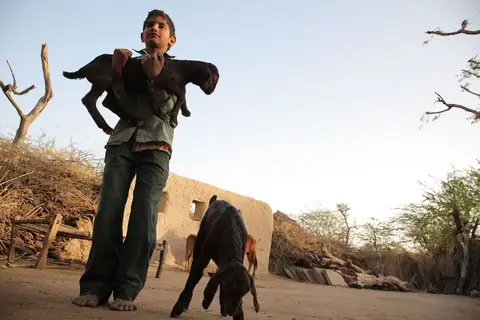 Poultry, goat & piggery